Enviro News Asia, Jakarta — Indonesia recorded a significant decline in high-confidence forest and land fire hotspots, with the national total falling by 362 points as authorities continued integrated efforts to control fires across affected regions.
Based on monitoring by the Forestry Ministry’s SiPongi system using NASA Terra/Aqua, SNPP and NOAA-20 satellite data, 213 high-confidence hotspots were detected nationwide as of September 25, 2026, at 9:10 p.m. local time. The figure dropped from 575 hotspots recorded the previous day.
Hotspots also declined in most of the six priority provinces for forest and land fire control. Central Kalimantan recorded 57 hotspots, down from 261, while South Sumatra recorded 17, down from 25.
West Kalimantan recorded 14 hotspots, compared with 26 previously, while South Kalimantan declined to six from nine. Jambi recorded one hotspot after reporting none the previous day, while Riau remained at zero.
The Forestry Ministry said the decline was particularly significant in Central Kalimantan. However, field operations and vigilance would continue because fire conditions can change rapidly depending on weather, land moisture, wind and the availability of surface and peat fuel.
The ministry also emphasized that satellite-detected hotspots represent surface temperature anomalies and cannot be directly equated with the number of fires or the area burned. A single fire can produce several hotspot detections, making ground verification necessary.
Ground and Aerial Operations Continue
Forest and land fire control operations are continuing through coordinated ground and aerial deployments.
The government has prepared 61 aircraft, comprising 17 units for patrols and weather modification operations and 44 units for water bombing.
A total of 55 aircraft are supporting operations in the six priority provinces, while six additional water-bombing aircraft have been deployed to assist firefighting in other affected areas.
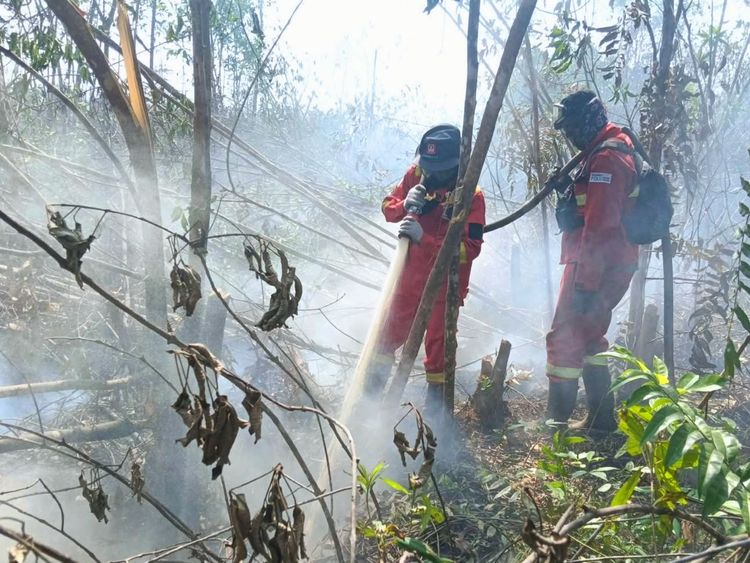
On the ground, the Forestry Ministry’s Manggala Agni firefighting teams are working with the National Disaster Management Agency, Indonesian Military, National Police, regional disaster management agencies, local governments, communities, volunteers and businesses.
Their activities include patrols, ground verification, direct firefighting, firebreak operations, wetting, mopping up and cooling.
Particular attention remains focused on peatland areas because embers can persist beneath the surface even after visible flames have disappeared. Wetting and cooling operations therefore continue until areas are considered safe.
Air Quality Remains a Concern
PM2.5 monitoring indicates varying air quality conditions across Indonesia. Most areas remain in the good to moderate categories, but several locations in Kalimantan and parts of Sumatra continue to record unhealthy to very unhealthy conditions, with locally higher particulate concentrations.
The Forestry Ministry noted that a decline in hotspots does not immediately translate into improved air quality. Smoke can remain in the atmosphere and move according to atmospheric conditions and wind direction, while peat fires can generate smoke for extended periods.
Residents in affected areas are advised to monitor air-quality information and follow guidance from local authorities. If air quality deteriorates, people are advised to reduce outdoor activities and wear masks when outdoor activities are necessary.
Wildlife Protection Remains Part of Fire Response
Fire control efforts are also aimed at protecting wildlife and their habitats. Forest and land fires can disrupt wildlife movement, reduce food availability and force animals out of their habitats toward plantations and settlements.
Through its Natural Resources Conservation Agency offices and conservation partners, the Forestry Ministry continues to deploy wildlife rescue teams in areas vulnerable to forest and land fires.
Patrol teams are tasked not only with detecting fires but also with identifying injured, trapped or displaced wildlife that may require evacuation.
The ministry urged residents who encounter orangutans or other wildlife near fire-affected areas not to attempt rescue or handling themselves. Residents should maintain a safe distance, record the location if it can be done safely and immediately report the animal to the relevant Natural Resources Conservation Agency or the nearest forestry official.
Public Vigilance Remains Essential
The Forestry Ministry urged communities and businesses not to clear or prepare land by burning. Authorities said the recent decline in hotspots needs to be maintained to prevent fire activity from increasing again as weather conditions become drier.
Residents are also encouraged to report smoke, fire points, burning activities or affected wildlife to authorities.
Reports of forest and land fires can be submitted to the Forestry Ministry’s Fire Control Post through its official telephone, WhatsApp and email channels. (*)