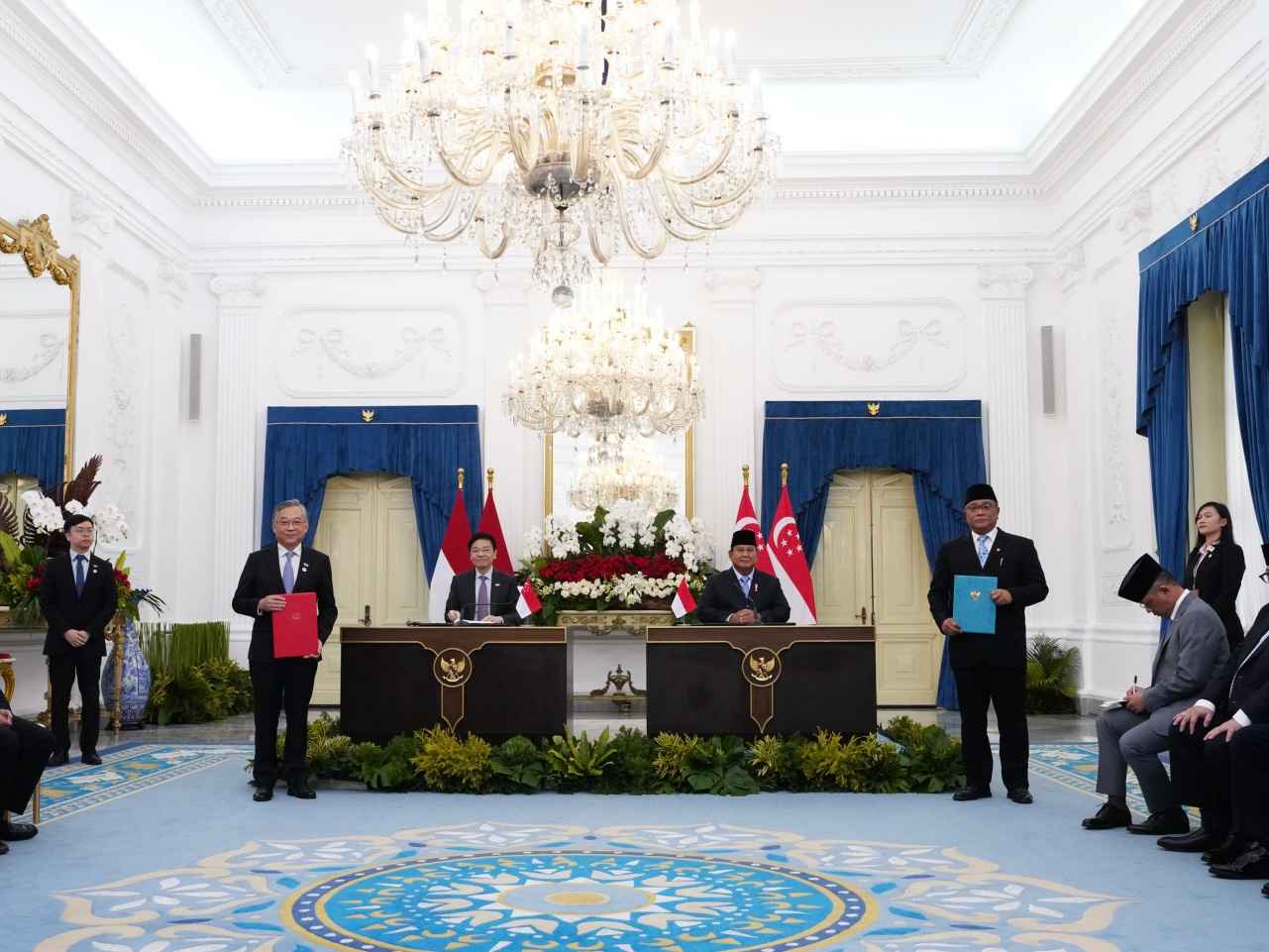
Enviro News Asia, Jakarta – The Indonesian government, through the Ministry of Environment/Environmental Control Agency (KLH/BPLH), has cemented its role in global climate diplomacy through two strategic agreements with Singapore, formalized at the bilateral Leaders’ Retreat between President Prabowo Subianto and Prime Minister Lawrence Wong at Istana Merdeka, where environmental protection was officially established as a key pillar of the two countries’ partnership.
The occasion was marked by the signing of a Memorandum of Understanding on Environmental Protection Cooperation and an MOU on Carbon Credit Collaboration under Article 6 of the Paris Agreement. Both agreements were signed by Minister of Environment/Head of BPLH Moh. Jumhur Hidayat alongside Singapore’s Minister for Sustainability and the Environment Grace Fu and Deputy Prime Minister and Minister for Trade and Industry Gan Kim Yong.
“This MOU serves as an overarching framework that will be followed through various more operational forms of cooperation, from climate change, waste management, and air pollution control to circular economy and carbon governance. We hope this cooperation delivers real benefits for both countries while strengthening our joint efforts in facing global environmental challenges,” Minister Jumhur said when signing the Environmental Protection Cooperation MOU with Minister Fu on June 29, 2026.
The strategic move aligns with President Prabowo Subianto’s Asta Cita vision of realizing green economic transformation. The twin agreements provide an essential foundation for Indonesia and Singapore to protect cross-border ecosystems while accelerating climate change mitigation through high-integrity and equitable carbon credit governance.
To realize the cooperation, both countries will strengthen operational instruments through civil servant capacity building, joint research, technical expert exchanges, and the creation of innovative pilot projects to build environmental resilience across Southeast Asia.
The carbon credit collaboration under Article 6 of the Paris Agreement marks Indonesia’s strategic commitment to positioning itself within a credible international carbon trading architecture. Responding to the cooperation milestone, Gan Kim Yong shared his vision on the importance of integrity, climate finance, and social impact delivered by the agreements.
“Singapore is committed to being a trusted partner in building a credible, transparent, and mutually beneficial carbon market. This MOU signals Singapore’s and Indonesia’s resolve to work together to establish a framework for channeling climate finance into high-integrity projects, from forest conservation and coastal ecosystem restoration to clean technology solutions that reduce emissions while creating new economic opportunities. Crucially, these projects will support the livelihoods and deliver direct benefits for local and indigenous communities most affected by climate change,” Gan Kim Yong said.
As an operational follow-up, both governments will formulate an Implementation Agreement governing authorization mechanisms, verification, the transfer of Internationally Transferred Mitigation Outcomes (ITMOs), and the application of corresponding adjustments to prevent double counting of national greenhouse gas emission reductions.
For the Indonesian government, the success of this green diplomacy will strengthen the credibility of Carbon Economic Value implementation in the eyes of the world. The carbon market must guarantee prosperity and climate justice while being designed to be equitable and high-integrity for all its actors. In line with the spirit of Asta Cita, the cooperation will strengthen Carbon Economic Value actors and ensure that economic benefits from credible, high-integrity, and inclusive carbon values can be felt directly at the field level, toward realizing climate justice for all Indonesians.
KLH/BPLH expressed confidence that this joint work roadmap will accelerate inclusive green development, describing the agreements as a concrete manifestation of the government’s commitment to the principle of no generation left behind, ensuring today’s green transition becomes a legacy of prosperity rather than a burden for the future. (*)