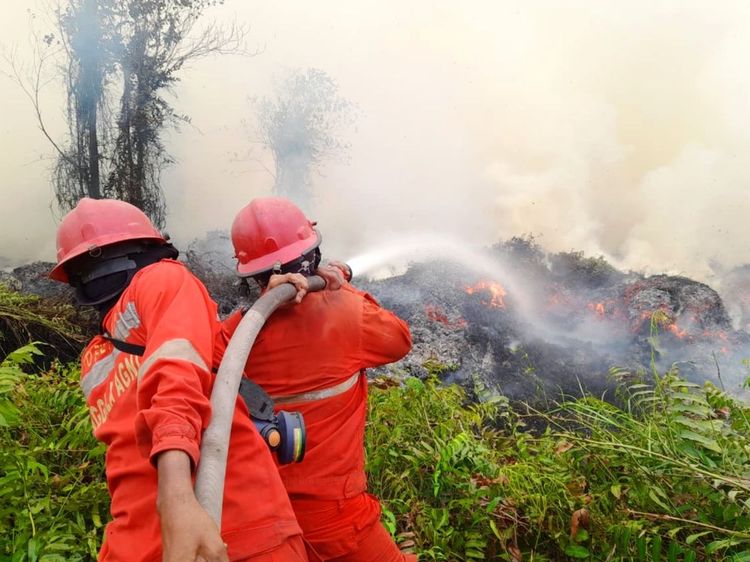
Enviro News Asia, Jakarta — Indonesia is maintaining intensive forest and land fire suppression efforts despite a decline in high-confidence hotspots, as authorities continue to battle fires, lingering smoke and poor air quality in parts of Sumatra and Kalimantan.
The Forestry Ministry recorded 270 high-confidence hotspots nationwide as of 9 p.m. on Saturday, Oct. 17, down by 84 from 354 a day earlier. Across six priority provinces, the number fell from 177 to 125.
Central Kalimantan, however, recorded a sharp increase, with 92 hotspots compared with 19 the previous day. West Kalimantan reported 22 hotspots, South Sumatra nine and South Kalimantan two, while Jambi and Riau recorded none.
The ministry cautioned that the national decline did not necessarily signal an end to the fire threat. Satellite-detected hotspots indicate surface temperature anomalies and must be verified on the ground. A single fire may generate multiple detections, meaning hotspot figures do not directly represent the number of fires or the total area burned.
Forestry Minister Raja Juli Antoni has continued monitoring firefighting operations in Central Kalimantan, including Tanjung Puting National Park and Sampit in East Kotawaringin regency.
On Saturday, aerial water-bombing operations in Tanjung Puting conducted 16 sorties. Authorities were also preparing to deploy two additional military helicopters and one Forestry Ministry helicopter to strengthen aerial suppression efforts.
Ground teams have been improving access to fire sites, installing and using boreholes, and deploying pumps and water distribution networks. Manggala Agni firefighting crews are working alongside the military, police, regional disaster management agencies, volunteers and local residents to protect the national park, including its core zone and orangutan habitat.
After visiting Tanjung Puting, Raja Juli continued to Sampit on Saturday night to inspect fire conditions and the work of personnel containing the blazes.
Peatland fires remain particularly difficult to extinguish because embers can persist beneath the surface after visible flames disappear. Crews are continuing to wet affected areas, cool hot spots and conduct mop-up operations to prevent fires from reigniting.
In South Sumatra, the Forestry Ministry is working with the Meteorology, Climatology and Geophysics Agency (BMKG) and the Indonesian military on weather modification operations scheduled for Oct. 16–25. The operation is intended to support firefighting and reduce smoke concentrations.
Teams use dry ice to help weaken atmospheric inversion layers that can trap smoke near the ground. When atmospheric conditions are suitable for rain formation, sodium chloride, or NaCl, can also be used for cloud seeding.
On Saturday, crews conducted one dry-ice seeding sortie using about 800 kilograms of material and one NaCl seeding sortie. Monitoring indicated that visibility in Palembang improved during the operation, although authorities said the broader firefighting response would continue.
The government has kept 61 aircraft on standby nationwide, including 17 for patrols and weather modification and 44 for water bombing. Ground operations include direct suppression, firebreak efforts, patrols, ember searches and cooling operations.
Air quality remains a concern despite the decline in hotspots. PM2.5 monitoring showed that most areas of Indonesia had good to moderate air quality, but localized areas in parts of Kalimantan and Sumatra continued to experience unhealthy, very unhealthy or hazardous conditions.
Smoke from peatland fires can persist and travel with atmospheric conditions, meaning improvements in hotspot counts may not immediately translate into better air quality. Authorities are therefore continuing to prioritize fire suppression and public health protection.
Residents in areas with deteriorating air quality have been advised to limit outdoor activities and wear masks when going outside. Children, pregnant women, older people and those with respiratory conditions or chronic illnesses are considered particularly vulnerable.
The Forestry Ministry has also urged residents and businesses not to clear land by burning. Anyone who encounters smoke, fire or land-burning activities is encouraged to report them promptly to authorities.
The ministry said operations would continue until fires and underground embers were extinguished, smoke emissions decreased and affected communities could safely resume their activities. (*)