Enviro News Asia, Jakarta — Indonesia’s Forestry Ministry is strengthening oversight of forestry licensing procedures to prevent corruption, improve transparency and ensure accountability, with officials identifying early warning signs of potential irregularities at every stage of the permitting process.
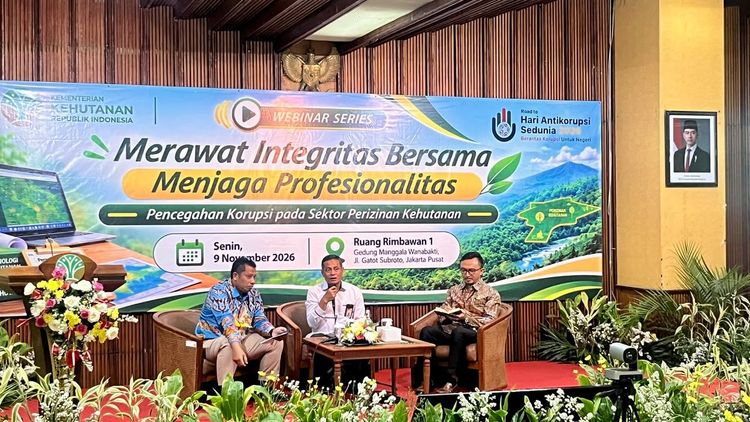
The initiative was highlighted during a corruption prevention webinar titled “Maintaining Integrity Together, Upholding Professionalism” held on Nov. 9 as part of the ministry’s preparations for the 2026 World Anti-Corruption Day (Hakordia).
Organized by the ministry’s Inspectorate General, the hybrid event took place at the Manggala Wanabakti Building in Jakarta and was also accessible through Zoom. It followed a July 15 workshop focusing on corruption prevention in approvals for forest-area use and forest-area release.
Forestry Ministry Secretary-General Mahfudz opened the webinar, followed by a keynote address from Ade Tri Ajikusumah, director general of forestry planning and acting inspector general.
Ade said improving licensing services required regulatory improvements, digital technology, integrated geospatial data and stronger staff capacity and integrity. These measures, he said, should make procedures clearer and more transparent while providing greater certainty for applicants.
He also stressed the need to strengthen supervision of permit holders to ensure they continued meeting their obligations after approvals were issued.
The main session featured Edi Suryanto, director of coordination and supervision for Region IV at the Corruption Eradication Commission (KPK), and M. Arief Priana, the Forestry Ministry’s inspector of investigations. They discussed ways to identify and mitigate corruption risks in forestry licensing.
The speakers outlined potential vulnerabilities throughout the permitting process, from application submissions and document reviews to technical assessments, decision-making and the fulfilment of obligations after approval.
They emphasized that red flags did not necessarily indicate that corruption had occurred. Rather, such signs required further clarification, examination and supervision to determine whether misconduct was taking place.
Potential warning signs included communication outside official service channels, unclear application processing times, unauthorized changes to maps and geographical coordinates, conflicts of interest during technical assessments, and failure by permit holders to fulfil their obligations.
The webinar also addressed conflict-of-interest management. Didik Agung Widjanarko, a special adviser to the forestry minister for inter-agency relations and tenure conflicts, said integrity was fundamental to public service and official decision-making.
He said officials must identify, report and properly manage actual or potential conflicts of interest to protect the objectivity of their decisions. Personal interests must remain separate from official responsibilities, while abuse of authority must be avoided.
Participants included officials and employees from the ministry’s secretariat-general, forestry planning directorate-general and inspectorate-general, as well as auditors and other relevant personnel.
External participants included applicants and holders of forest-area use and release approvals, business representatives, government institutions and regional administrations. Senior officials from the ministry’s forestry planning directorate-general also contributed to discussions on licensing risks and preventive measures.
The Inspectorate General said corruption prevention was a shared responsibility, not solely the task of internal auditors and supervisory bodies. The forestry planning directorate-general, as the unit responsible for licensing services, was expected to ensure that every process complied with regulations and remained transparent and accountable.
Applicants and permit holders were also urged to follow official procedures, fulfil their obligations and refrain from offering gratification or attempting to influence administrative decisions.
The ministry said cooperation among its Inspectorate General, technical units, the KPK, businesses and other stakeholders needed to extend beyond awareness campaigns. It must translate into daily professional conduct, service improvements and consistent monitoring at every stage of the licensing process.
Through the webinar series, the ministry aims to reinforce integrity across forestry licensing services and strengthen practical anti-corruption measures ahead of Hakordia 2026, supporting cleaner governance and the sustainable management of Indonesia’s forests. (*)