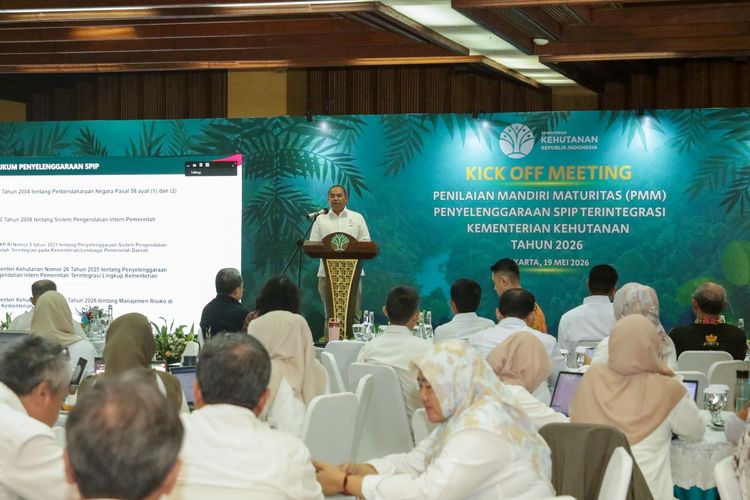
Enviro News Asia, Jakarta — Indonesia’s Ministry of Forestry has officially launched the 2026 Integrated Government Internal Control System (SPIP) Self-Assessment initiative as part of efforts to strengthen governance, risk mitigation, and internal control mechanisms in managing the country’s vast forest resources covering approximately 120 million hectares, or around 60 percent of Indonesia’s land area.
The initiative was marked through a hybrid kick-off meeting attended by around 600 participants from central and regional working units. Secretary General of the Ministry of Forestry, Mahfudz, who also serves as Coordinator of the 2026 Integrated SPIP Self-Assessment, emphasized that the forestry sector faces highly complex risks, ranging from administrative and operational challenges to land tenure conflicts, forest governance issues, and potential fraud in natural resource management.
“Indonesia’s forest resources are extraordinary in scale and value. This immense wealth brings equally significant challenges. Therefore, the Government Internal Control System must function as a concrete instrument to ensure forestry development objectives are achieved effectively, efficiently, and accountably,” Mahfudz stated during the opening session on Tuesday, 19 May 2026.
He stressed that the effectiveness of forestry programs should not merely be measured by administrative achievements, but by their real impact on society, including poverty alleviation for communities living around forest areas.
Mahfudz also acknowledged that the Ministry recorded several governance gaps during the institutional transition period into the Ministry of Forestry. The 2025 evaluation results highlighted areas requiring further strengthening, particularly in ensuring that internal control mechanisms are implemented effectively at the operational level.
“The most important thing is not simply maintaining scores or ratings, but ensuring that internal control truly works in the field,” he said.
The Ministry also recorded a sharp increase in Non-Tax State Revenue (PNBP), reaching Rp13.4 trillion in the first quarter of 2026. In response, Mahfudz instructed all units to strengthen early detection systems and tighten oversight in areas considered highly vulnerable to governance risks.
As part of governance improvement measures, the Ministry highlighted several recommendations from the Financial and Development Supervisory Agency (BPKP), including stronger integration of risk management, concrete follow-up action plans, fraud risk identification, periodic monitoring systems, tighter management of state revenues and assets, and capacity building for human resources.
To support the implementation process, the Ministry has established a Self-Assessment Task Force and an SPIP Implementation Team through Ministerial Decrees No. 1951 and 1952 of 2026. The teams will oversee all implementation stages, including technical guidance, internal assessments, and quality assurance processes conducted by the Inspectorate General before submission to BPKP.
The kick-off meeting also involved external strategic partners who provided technical briefings on supervisory strengthening, fraud control systems, and risk management frameworks aimed at supporting more accountable forestry governance.
“We aim to build a strong control culture and risk culture within the Ministry, not merely accumulate assessment documents,” Mahfudz concluded. (*)