
Enviro News Asia, Mimika — Indonesia’s Ministry of Forestry has uncovered several methods used to traffic protected wildlife in Mimika Regency, Central Papua, and named four people as suspects in two separate cases involving protected wildlife and 534 pig-nosed turtle eggs.
The suspects, identified by their initials as R, 32, MN, 34, M, 46, and A, 56, were arrested following an operation conducted by the Ministry of Forestry’s Maluku and Papua Forestry Law Enforcement Office from September 11 to 17, 2026.
In the first case, officers found products made from parts of cassowaries and birds-of-paradise being traded at three business locations in Jalan Jenderal Ahmad Yani, Kwamki, Mimika Baru District, on September 14.
Following an investigation and case review on September 28, R, MN and M were named suspects.
Two days later, on September 16, forestry officers, working with the Mimika Police and local environmental authorities, followed up on information about a rented house on Jalan Melati, Kaperapoka Village.
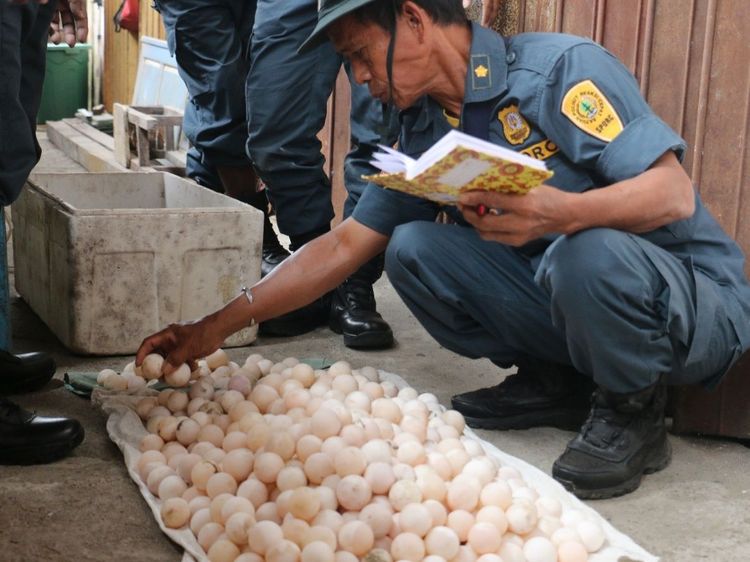
The team found 534 eggs of the pig-nosed turtle (Carettochelys insculpta), along with containers used to store them. The eggs were evacuated to the Timika Wildlife Conservation Section II Office for further handling and identification.
The investigation found that the eggs were allegedly being circulated in an attempt to hatch them after they reached their intended destination. Authorities are continuing to investigate the origin of the eggs, their intended destination, the distribution network and other parties who may have been involved.
Director General of Forestry Law Enforcement Dwi Januanto Nugroho said wildlife protection efforts in Papua must respond to changing patterns of illegal trade while maintaining the relationship between natural resources and local communities.
“Papua has natural wealth that has grown together with the lives of its people, giving rise to knowledge, traditions and identities passed down through generations,” Januanto said.
He added that protecting wildlife is also linked to safeguarding cultural traditions associated with Papua’s natural environment. He said the discovery of wildlife trafficking involving eggs showed the need for law enforcement to adapt to changing methods of illegal trade.
Head of the Maluku and Papua Forestry Law Enforcement Office Fredrik E. Tumbel said the investigation would not stop with the suspects and evidence already secured.
“In one operation, we found traded parts of protected wildlife as well as hundreds of protected wildlife eggs,” Tumbel said. “Four people have been named suspects based on facts and evidence obtained during the investigation.”
He said investigators were continuing to trace the origin and destination of the 534 pig-nosed turtle eggs and identify other parties potentially involved in their distribution.
R, MN and M are charged under Article 40A paragraph (1) letter f in conjunction with Article 21 paragraph (2) letter c of Law No. 32 of 2024, which amended Law No. 5 of 1990 on the Conservation of Biological Natural Resources and Their Ecosystems.
A is charged under Article 40A paragraph (1) letter g in conjunction with Article 21 paragraph (2) letter d of the same law.
The Ministry of Forestry said it would continue strengthening monitoring and law enforcement against illegal wildlife and plant trafficking, including the circulation of live animals, eggs, body parts and other forms prohibited under Indonesian regulations.
The ministry also called for public participation through information sharing and reporting to help protect Papua’s biodiversity and prevent further illegal wildlife trafficking. (*)