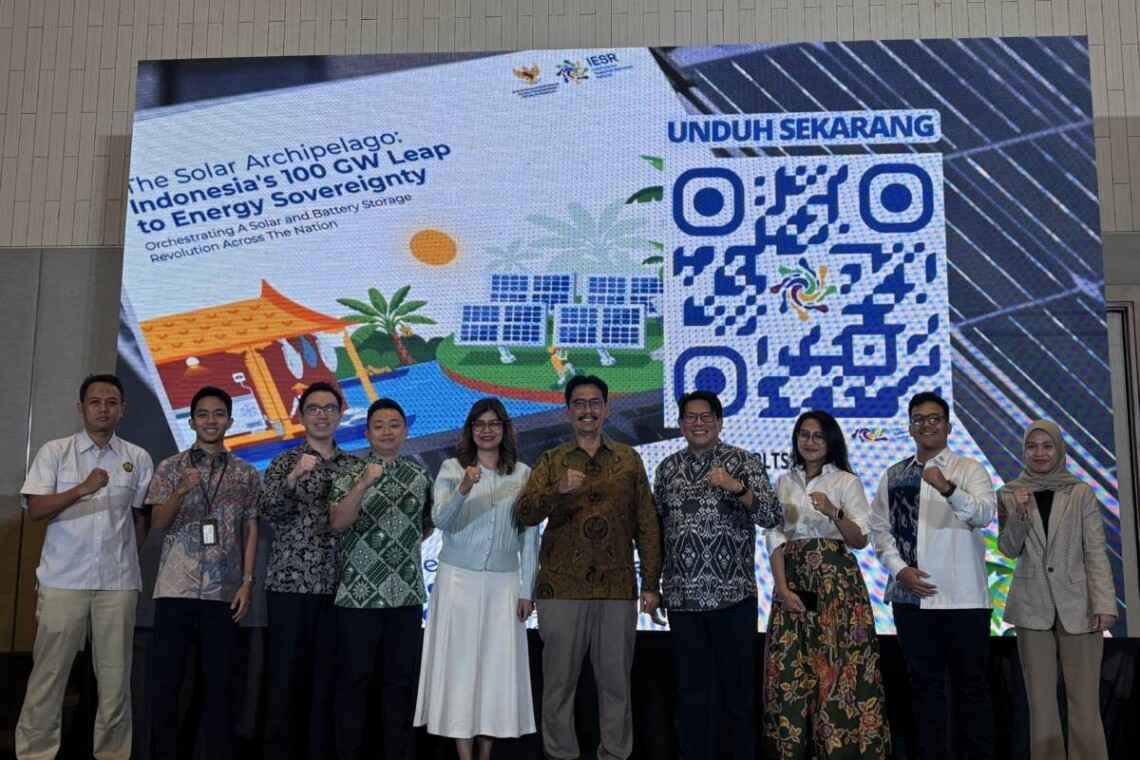
Enviro News Asia, Jakarta – The Institute for Essential Services Reform (IESR), in collaboration with the Kementerian Koordinator Bidang Perekonomian Republik Indonesia, officially launched a strategic study titled The Solar Archipelago: Indonesia’s 100 GW Leap to Energy Sovereignty on Monday (23/2).
The study outlines the implementation roadmap for President Prabowo Subianto’s directive to develop 100 gigawatts (GW) of solar power capacity, first announced in mid-2025. It presents a comprehensive strategy for deploying large-scale solar photovoltaic (PV) systems alongside Battery Energy Storage Systems (BESS), positioning solar energy as a cornerstone of Indonesia’s energy security and equitable development agenda.
The report proposes two primary strategies. First, accelerating the phased retirement of high-cost, high-emission diesel power plants in alignment with PLN’s Electricity Supply Business Plan (RUPTL). Second, developing village-scale solar energy systems to support rural cooperatives, local industries, cold storage chains, micro, small, and medium enterprises (MSMEs), and other productive economic activities.
Sunandar, Assistant Deputy for Electricity and Geology Development at the Coordinating Ministry for Economic Affairs, emphasized that energy transition can align with economic growth. He noted that clean energy can serve as a foundation for higher-quality growth while maintaining carbon intensity at manageable levels.
“The 100 GW solar initiative creates significant opportunities for domestic industries by providing market certainty to attract investments in solar panel manufacturing and local supply chain development. It will strengthen national industries, create jobs, and deliver tangible benefits to communities by supporting productive economic activities in rural areas,” Sunandar stated.
Fabby Tumiwa, Chief Executive Officer of IESR, highlighted Indonesia’s potential to transform from a fossil fuel-dependent nation into a renewable energy leader in Southeast Asia. Indonesia possesses an estimated 7.7 terawatts (TW) of technical solar potential, capable of delivering reliable and competitive electricity to support green economic growth and high-quality electrification.
According to IESR’s projections, with appropriate governance, transparent procurement, independent oversight, and institutional capacity strengthening, the 100 GW solar program could provide reliable and affordable electricity to tens of millions of citizens. The initiative is also projected to save up to Rp21 trillion in fuel subsidies, mobilize between USD 50–70 billion in solar investment, create approximately 118,000 green jobs, and reduce greenhouse gas emissions by up to 24 million tons of CO₂ equivalent.
The study estimates financing needs of around USD 70 billion over five years and underscores the importance of cross-ministerial coordination, green financing mechanisms, banking support, and private sector participation. Workforce capacity development is also critical, particularly for installation, operation, and maintenance (O&M), with expanded training programs across provinces.
In the initial phase, IESR identified 26 GW of decentralized solar PV integrated with BESS, focusing on diesel replacement in remote and outermost regions (3T areas), rural electrification for under-electrified communities, and productive energy use to stimulate local economies.
To prevent fossil-based overcapacity and stranded assets, the study recommends integrating the remaining solar capacity into PLN’s RUPTL and accelerating the retirement of aging coal-fired power plants before 2030, alongside reducing or canceling new coal plant developments.
The report also proposes a structured 180-day action plan. Key measures include issuing a Presidential or Presidential Instruction regulation to establish a dedicated task force; developing standardized mini power purchase agreements (mini-PPA); securing state budget and international financing; capitalizing a Village Energy Facility through PT SMI; announcing bundled regional solar projects in East Nusa Tenggara (NTT), Maluku, and Papua; launching a Green Skills Compact to certify at least 5,000 technicians; and establishing a national O&M fund with a performance-based monitoring dashboard.
Through the 100 GW Solar Initiative, Indonesia aims to enhance energy resilience, achieve greater energy self-sufficiency, and expand access to reliable electricity—ensuring that the benefits of sustainable development are distributed equitably across the archipelago. (*)