Enviro News Asia, Jakarta – The revitalization of natural and plantation forests has been identified as a strategic step to strengthen the competitiveness of Indonesia’s national forestry sector amid declining forest productivity, growing demands for a green economy, and the need to achieve the country’s FOLU Net Sink 2030 targets.
Ministry of Forestry Secretary General Mahfudz affirmed that the revitalization of natural and plantation forests must become a shared agenda to build more productive, inclusive, and sustainable national forestry governance.
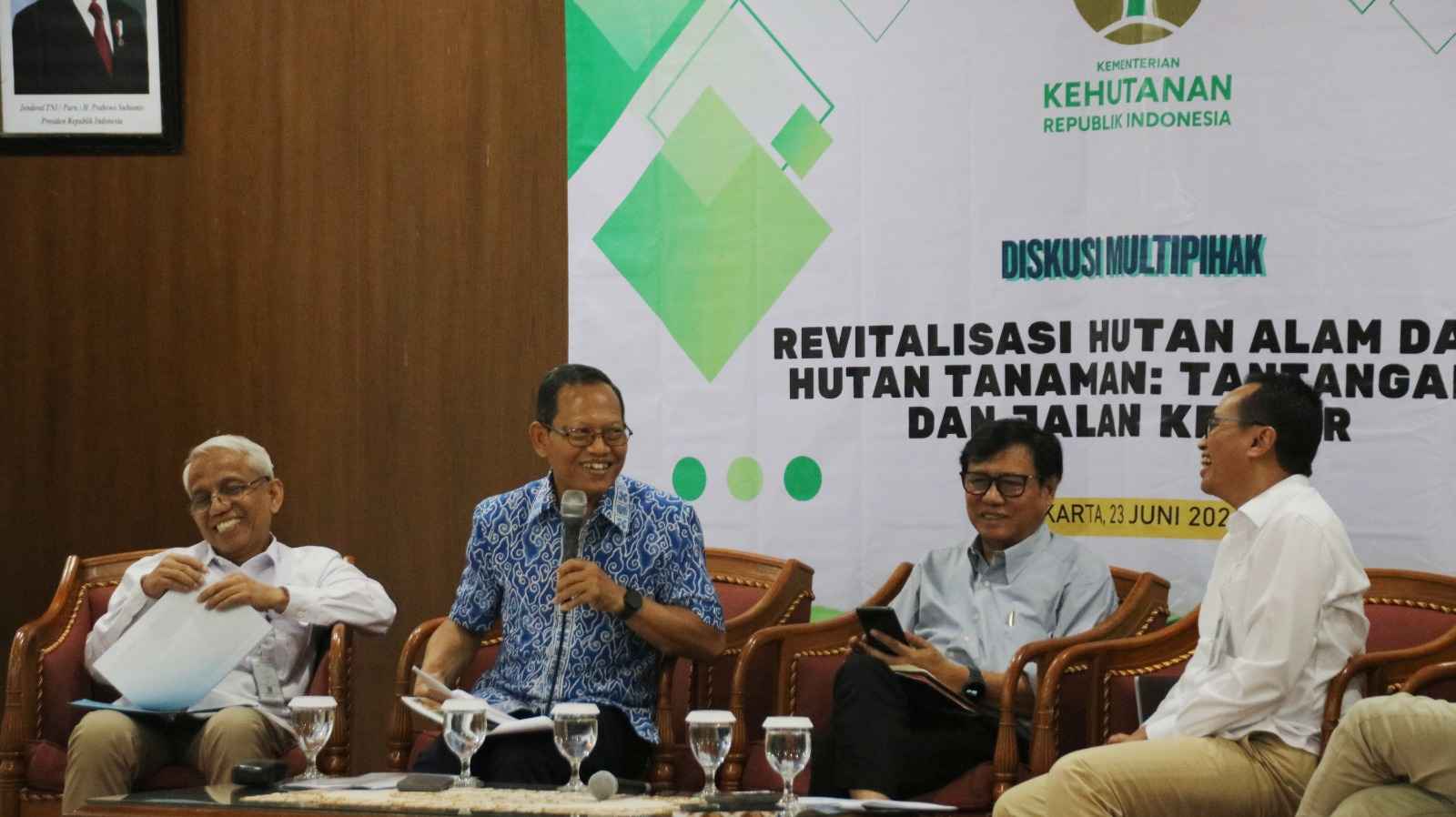
“Forest revitalization is not only about improving productivity, but also about ensuring that forest management can deliver balanced economic, social, and environmental benefits for communities and the state,” Mahfudz said at the opening of the Multi-Stakeholder Discussion on “Natural and Plantation Forest Revitalization: Challenges and Solutions” in Jakarta on Tuesday (6/23/2026).
He said forest management going forward must be capable of addressing declining productivity, industrial raw material needs, social pressures at the field level, and Indonesia’s commitment to meeting national climate targets through the FOLU Net Sink 2030 agenda.
Ministry of Forestry Director for Forest Utilization Business Control Khairi Wenda said the revitalization of forest business utilization is directed toward transforming the sector from a timber-oriented model to multi-business forestry.
“Forest management can no longer rest on timber alone. Multi-business forestry must be developed through the utilization of timber products, non-timber forest products, environmental services, carbon, agroforestry, and community partnerships,” Khairi Wenda said.
He said the revitalization strategy for forest business permit (PBPH) holders will focus on improving stand growth rates, restoring the ecological value of areas, applying Reduced Impact Logging-Carbon, intensive silviculture, developing carbon trading, ecotourism, downstream processing of forest products, and strengthening concession partnerships.
Indonesian Forest Entrepreneurs Association (APHI) Chairman Soewarso said the forestry sector requires a management reconfiguration to maintain its competitiveness and deliver a greater contribution to the national economy.
“Timber products can no longer serve as the sole source of income. The potential of environmental services, carbon, biodiversity, and non-timber forest products must be optimized to make forest management more sustainable,” Soewarso said.
He identified the main challenges facing the forestry sector as high production costs, tenurial conflicts, uncertainty over business areas, low industrial value-added, and suboptimal utilization of environmental services. APHI is therefore pushing for stronger multi-business forestry development, downstream processing of high value-added products, and concession partnerships with communities.
IPB University Faculty of Forestry and Environment Professor Bramasto Nugroho stressed that the governance of natural and plantation forests is a complex issue requiring the involvement of all stakeholders.
“Forests are a shared resource whose management requires respected rules, strong institutions, and effective enforcement,” Bramasto said, adding that governance improvements must be carried out in an adaptive manner as the forestry sector involves not only upstream but also downstream aspects, industry, markets, value-added improvement, productivity, competitiveness, and social and political dynamics at the field level.
The multi-stakeholder discussion reaffirmed the importance of collaboration among government, business actors, academics, and communities in carrying out natural and plantation forest revitalization. Through this approach, the forestry sector is expected to increasingly protect ecological functions, strengthen its contribution to the green economy, and improve the welfare of communities around forests. (*)