
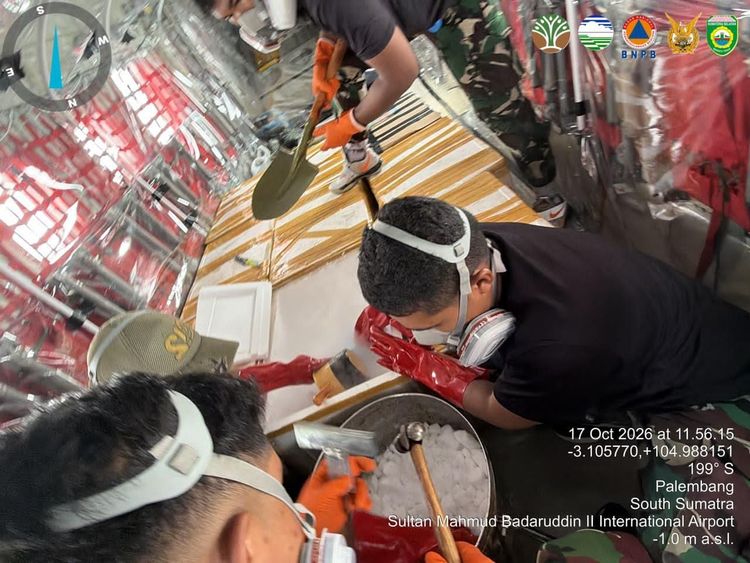
Enviro News Asia, Palembang — Indonesia’s Ministry of Forestry, the Meteorology, Climatology and Geophysics Agency (BMKG), and the Indonesian Military (TNI) are conducting weather modification operations using dry ice to help reduce haze from forest and land fires in South Sumatra.
The 10-day operation, running from October 16 to 25, 2026, aims to weaken atmospheric inversion layers that trap smoke and pollutants close to the ground. On the second day of the operation, visibility in Palembang improved compared with previous conditions, according to monitoring by the Sumatra Forest Fire Control Office.
Thomas Nifinluri, the ministry’s director of forest fire control, said the use of dry ice was intended to influence atmospheric temperatures and disrupt the stability of inversion layers. These layers form when warmer air sits above cooler air near the surface, preventing smoke from rising and dispersing.
“When smoke from forest and land fires becomes trapped near the surface because of an inversion layer, dry-ice weather modification can help weaken that layer and improve air movement,” Thomas said.
During the first day, an aircraft completed one sortie, dispersing 800 kilograms of dry ice around Palembang. Two sorties were planned for the second day, subject to weather conditions and atmospheric developments.
The operation will be adjusted according to changing atmospheric conditions. If the inversion layer weakens and conditions become favourable for rain-producing clouds, the authorities may combine dry ice with sodium chloride (NaCl) cloud seeding to support rainfall formation.
Thomas said the choice of seeding materials and flight schedules would depend on monitoring results and prevailing weather conditions.
Forest and land fire management in South Sumatra continues through a coordinated approach. Ground teams, including Manggala Agni forest firefighters, are working to extinguish fires at their sources, while aerial task forces support firefighting operations from the air. Weather modification is being used as a supporting measure to address atmospheric conditions and reduce the impact of smoke.
Dwi Januanto Nugroho, the ministry’s director general of forestry law enforcement, said the response must consider the effects of haze on communities, including air quality, public health, education, transportation and daily activities.
He stressed that firefighting, aerial operations, weather modification and law enforcement must work together to contain fires and reduce their effects on the public.
“We do not want to make claims before the results are clear. The priority is to bring the fires under control as soon as possible and reduce the impact on communities,” Januanto said.
The Ministry of Forestry, BMKG, TNI, regional governments and other stakeholders will continue monitoring fire conditions, visibility, air quality and atmospheric developments to assess the effectiveness of ongoing measures and determine subsequent actions. Ground-based prevention and firefighting remain the primary efforts to control the sources of fires. (*)