
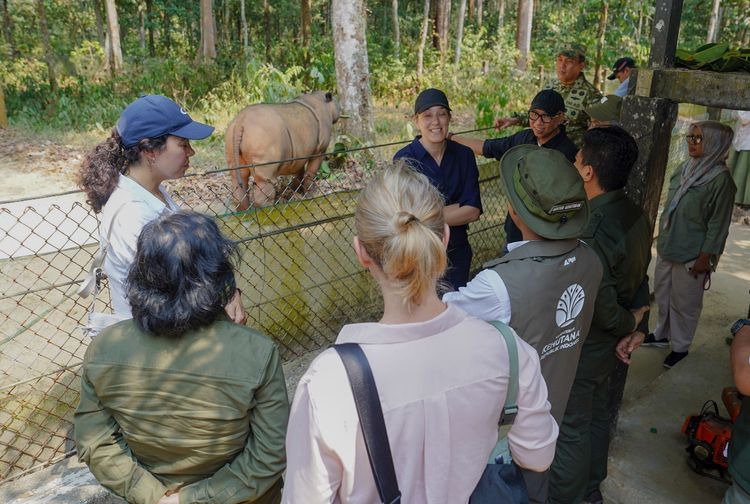
Enviro News Asia, Lampung — Forestry Minister Raja Juli Antoni and Norway’s Ambassador to Indonesia Kaja Glomm visited Way Kambas National Park in Lampung on September 20, 2026, to review forest and land fire control, Sumatran elephant conservation and measures to protect the Sumatran rhinoceros.
The visit focused on an integrated approach to protecting the Way Kambas landscape, including fire prevention, habitat security and efforts to reduce negative interactions between Sumatran elephants and communities living around the national park.
Raja Juli emphasized the importance of managing Way Kambas as one connected landscape. He said conservation efforts must not only prevent fires and protect wildlife habitat but also create safer conditions for animals and surrounding communities.
The visit began with an inspection of forest and land fire control efforts in Way Kambas National Park. The area has experienced several fires in recent weeks, prompting increased attention to prevention, personnel readiness, water sources and firefighting infrastructure.
The minister reviewed field preparedness and discussed measures being implemented to strengthen fire prevention and response.
The delegation then inspected barrier infrastructure designed to reduce negative interactions between Sumatran elephants and local communities.
Brig. Gen. TNI Sriyanto, Chairman of the Joint Committee for the Mitigation and Management of Negative Sumatran Elephant Interactions, accompanied the minister and explained the progress of the barrier construction and the mitigation system being prepared in the field.
The barrier is being developed not merely as a physical boundary but as part of an integrated mitigation system to reduce the risk of elephants leaving the conservation area and entering residential areas or community farmland.
Improved infrastructure and monitoring are expected to strengthen community safety while supporting better management of Sumatran elephants.
The minister also observed trained elephants that have supported management and mitigation activities in Way Kambas. He explained to Ambassador Glomm that the elephants require a gradual adaptation process as the park’s barrier and security systems become more complete and operational.
The long-term goal is to reduce the use of chains on trained elephants as the conservation area develops safer systems for managing their movement.
Ambassador Glomm asked whether the objective was to eventually remove the chains.
“That’s the ambition, to unchain?” she asked.
“Yes,” Raja Juli replied.
The exchange reflected the direction of ongoing management improvements at Way Kambas: creating safer systems that can improve elephant welfare while maintaining the safety of communities, personnel and wildlife.
The transition will be carried out gradually, taking into account infrastructure readiness, the behavior and adaptation of individual elephants, and the effectiveness of the park’s security and monitoring systems.
The visit also highlighted the interconnected nature of conservation. Forest and land fire control helps protect wildlife habitat, elephant conflict mitigation supports safer coexistence between wildlife and communities, while science and technology can provide additional options for conserving species with limited populations. (*)