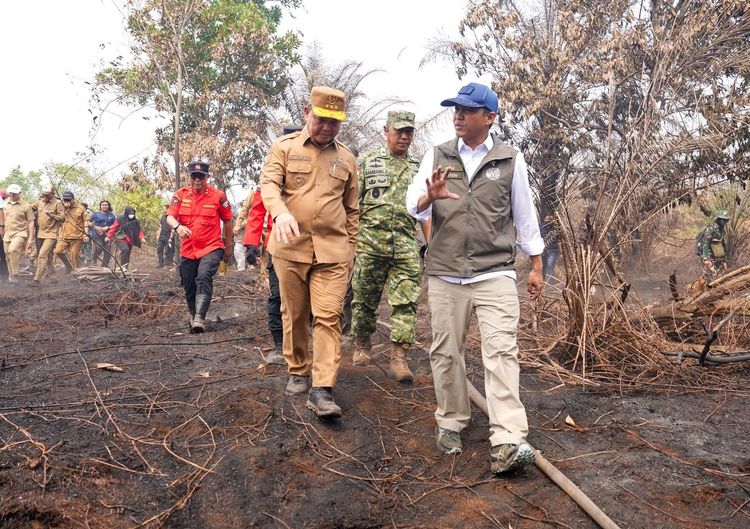
Enviro News Asia, North Sumatra — The Ministry of Forestry and the National Police’s Criminal Investigation Agency (Bareskrim Polri) presented preliminary forensic findings on log debris carried by the flash flood that struck Garoga, Batangtoru, South Tapanuli, North Sumatra. A joint investigation team conducted field inspections, measurements, and wood sampling along the affected riverbanks and bridge areas impacted by the recent flood and landslides.
The Directorate General of Watershed Management and Forest Rehabilitation (PDASRH) stated that extensive land-use conversion in West Sumatra, Aceh, and North Sumatra contributed significantly to the worsening floods at the end of November. The floods struck 13 watersheds across 11 districts and cities in North Sumatra.
PDASRH’s Subdirectorate Head for Watershed Management Planning, Catur Basuki Setyawan, reported that between 2019 and 2024, forest cover loss in these regions reached 9,424 hectares—36.4 percent within forest areas and 63.6 percent outside forest zones. He noted that in the Garoga Watershed alone, forest-to-nonforest land conversion reached 28,885 hectares, with only 0.4 percent occurring within forest areas and at least 99 percent outside designated forest regions.
Forest Ecosystem Controller Yandi Irawan Sutisna explained that the joint team gathered 43 wood samples from several locations, including Garoga Bridge 1, Garoga Bridge 2, and areas around kilometers 4, 6, and 8 along the Garoga River. At Garoga Bridge 1, investigators identified 18 samples representing 10 tree species. At Garoga Bridge 2, they found seven samples from six species, including nyatoh, bayur, rubber, puspa, and durian. The wood materials accumulated at narrow river sections, especially around bridges, increasing water pressure and intensifying the flood’s destructive impact on nearby settlements.
“To date, 15 tree species have been identified, while seven others remain under laboratory examination. Most of the samples are rubber, meranti, and durian—species that typically do not grow in natural forests,” Yandi said during a press briefing in Garoga on Wednesday, December 10, 2025. He added that each sample is being verified to determine whether it originated from felling, collapse, or landslide-related uprooting.
Kristo Damanik, Head of Planning and Evaluation at BPDAS Asahan Barumun, stated that the Garoga Watershed spans only about 58 kilometers from upstream to downstream. “With such characteristics, materials from the upstream can travel rapidly to the downstream area. This explains why large volumes of wood accumulated at Garoga Bridge 2, increasing water pressure and amplifying the flood impact,” he noted.
The investigation team also discovered steep land-clearing sites and several pieces of heavy equipment that have been secured as part of efforts to determine whether illegal land-clearing activities occurred.
Brigadier General Moh. Irhamni, Director of Specific Crimes at Bareskrim Polri, confirmed that investigators installed police lines at several key points along the Garoga River and conducted additional sampling. “Two bridges have been examined, and all critical areas have been cordoned off,” he stated.
The Ministry of Forestry emphasized its ongoing support in providing technical data, wood-sample identification results, watershed analyses, and relevant documentation to ensure that law enforcement proceeds objectively and based on scientific evidence. The government reaffirmed its commitment to firm action against any forest-management violations that jeopardize environmental integrity and public safety. (*)