Enviro News Asia, Jakarta – The Ministry of Forestry, through the Directorate General of Sustainable Forest Management, is pushing the transformation of Indonesia’s forest management through the development of Landscape-Based Generative Multi-Business Forestry (MUK Generatif), an approach that integrates the utilization of timber products, non-timber forest products, environmental services, carbon trading, and agroforestry commodity development within a single sustainable management framework.
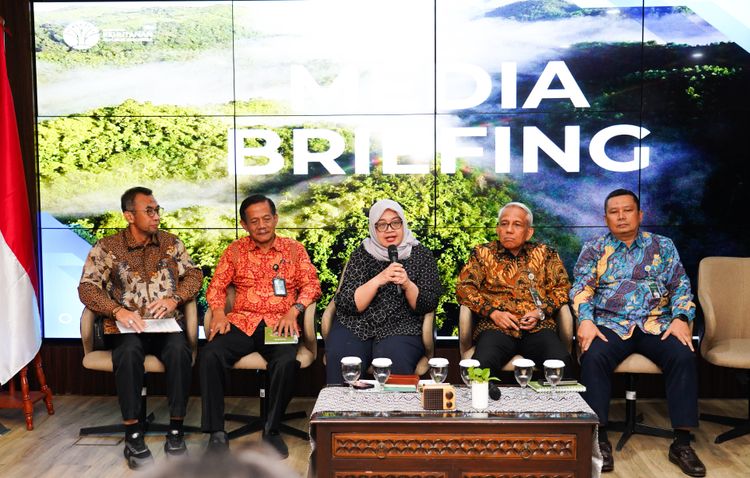
Director General of Sustainable Forest Management Laksmi Wijayanti, speaking at a media briefing at Manggala Wanabakti in Jakarta on Thursday (6/25), said Multi-Business Forestry is the answer to present-day forest management challenges that can no longer rely on a single timber-based utilization model.
“The concept of Multi-Business Forestry is to ensure that forest areas do not only produce a single benefit. For too long, forest utilization has leaned heavily on timber, while there is enormous untapped potential in non-timber forest products and environmental services. Through Multi-Business Forestry, every unit of value within a forest area can deliver higher economic benefits while maintaining its ecological functions,” Laksmi said.
She added that sustainable forest management today is not only about maintaining forest cover, but also about increasing the economic value of forest areas so they retain strong incentives to be preserved.
“If the economic value of forests is low, pressure to convert forest functions will only grow. That is why we are working to improve forest quality while increasing its economic value, so that communities and business actors receive sufficient benefits to keep protecting forests,” she said.
Through the Generative MUK approach, forest areas are managed under a “beneath one canopy” concept, where various productive activities can run in an integrated manner. Beyond timber production, forest areas can be developed for agroforestry commodities including coffee, cocoa, candlenut, kepayang, and damar, while also generating added value from environmental services and carbon trading.
The model also positions communities around forests as an important part of the forestry business value chain. Through partnerships between forest business permit holders and communities, the government hopes MUK can serve as an instrument for improving community welfare while reducing tenurial conflicts at the field level.
“Agroforestry will be the backbone of Multi-Business Forestry. That is why community partnerships are an inseparable part of this. We hope this approach can become a breakthrough in resolving field conflicts while creating new economic value for forest areas,” Laksmi said.
The Ministry of Forestry has prepared a number of priority landscapes for Generative MUK implementation, including the development of premium agroforestry-based coffee, sustainable cocoa, certified multi-commodity coffee and cocoa models, wetland and peatland agroforestry coffee development, and ecosystem restoration integrated with environmental services and carbon trading.
Beyond economic benefits, Generative MUK is also designed to strengthen environmental functions through increased carbon absorption, biodiversity conservation, and improved water retention capacity in forest areas.
The development of Generative Multi-Business Forestry also serves as an important instrument in supporting the implementation of Indonesia’s FOLU Net Sink 2030 agenda, under which the forestry and other land use sector is targeted to absorb more greenhouse gas emissions than it produces. Through strengthened agroforestry, increased vegetation cover, ecosystem restoration, and optimized environmental services and carbon trading, the Generative MUK scheme is expected to strengthen the forestry sector’s contribution to achieving national emission reduction targets, while demonstrating that forest conservation can go hand in hand with improved community welfare, job creation, and inclusive green economic growth.
Through Generative Multi-Business Forestry, the Ministry of Forestry is targeting the emergence of a new forest economy capable of making a significant contribution to national economic growth, job creation, increased agroforestry product exports, and supporting the achievement of sustainable development targets toward Indonesia Emas 2045. (*)