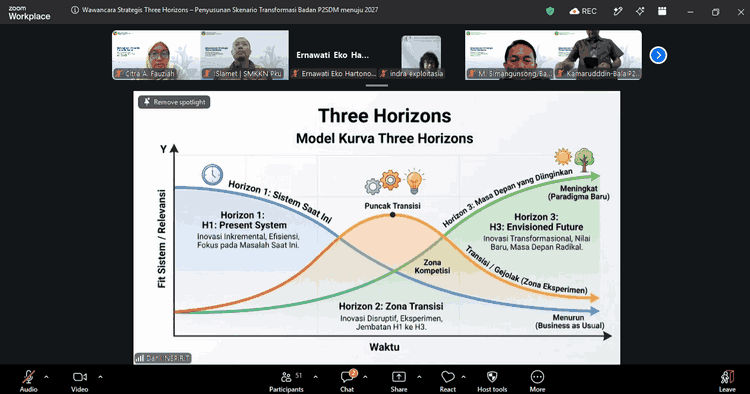
Enviro Neews Asia, Jakarta – Building adaptive forestry human resources capable of meeting future challenges requires the courage to evaluate existing systems and design new innovations. On that basis, the Human Resources Extension and Development Agency (BP2SDM) of the Ministry of Forestry held a Workshop on Drafting BP2SDM Transformation Scenarios Toward 2027 using the Three Horizons Framework approach on July 1–2, 2026.
The online workshop was attended by BP2SDM leadership, the Agency Secretary, heads of centers, regional BP2SDM center heads, state forestry vocational school principals, and structural officials at Echelon 3 and 4 levels, serving as a collaborative forum for formulating strategic steps to ensure BP2SDM’s transformation continues and is capable of responding to the dynamics of forestry development.
Over the past year, BP2SDM has made significant transformation strides, including the development of a Corporate University, a meritocracy system, the strengthening of an Assessment Center that achieved A-level accreditation, organizational culture building, the One Center One Innovation movement, and a paradigm shift positioning BP2SDM from a supporting system to a core system in forestry human resource development.
BP2SDM Head Indra Eksploitasia said the transformation achievements of the past year must serve as a foundation for going further.
“Transformation must not stop at the achievements already reached. We must keep moving from merely managing human resources toward building human capital that genuinely delivers impact for the organization, society, and the forestry sector,” he said.
Through the Three Horizons approach, participants were invited to view the organization from three simultaneous perspectives. Horizon 1 identifies systems and practices still relevant to be maintained. Horizon 2 maps innovations serving as a bridge toward change. Horizon 3 then formulates the ideal future state of BP2SDM as a more adaptive, modern organization oriented toward continuous learning.
Strategic ideas that emerged during discussions included the strengthening of the merit system, digitalization of services, teaching factory development at state forestry vocational schools, staff capacity building, and robust collaborative networks as important assets to preserve. The organization also needs to accelerate curriculum updates, improve learning quality, strengthen the character of forestry professionals, and ensure human resource development aligns with field needs.
For the transitional Horizon 2 phase, the forum produced a range of innovation recommendations to accelerate organizational transformation, including Corporate University implementation, digital learning development, information and data system integration, knowledge management strengthening, technology-based forestry extension transformation, and the optimization of Special Purpose Forest Areas (KHDTK) as forestry learning and innovation centers.
Horizon 3 envisions BP2SDM by 2027 as an orchestrator of national forestry human resource development, serving as a human capacity development center supported by an integrated data system, a Corporate University learning culture, the application of artificial intelligence, and KHDTK management as a forestry center of excellence.
Beyond producing strategic recommendations, the workshop aligned all work units’ understanding of the organization’s transformation direction. Its outcomes will be further discussed with BP2SDM leadership to determine policy priorities, regulatory needs, and implementation steps as part of the organizational transformation roadmap toward 2027, ultimately to be captured in a BP2SDM Transformation Scenario Document 2027 as a strategic reference for strengthening forestry human resource development governance and realizing Forestry Human Excellence as the foundation of Indonesia’s sustainable forestry development. (*)