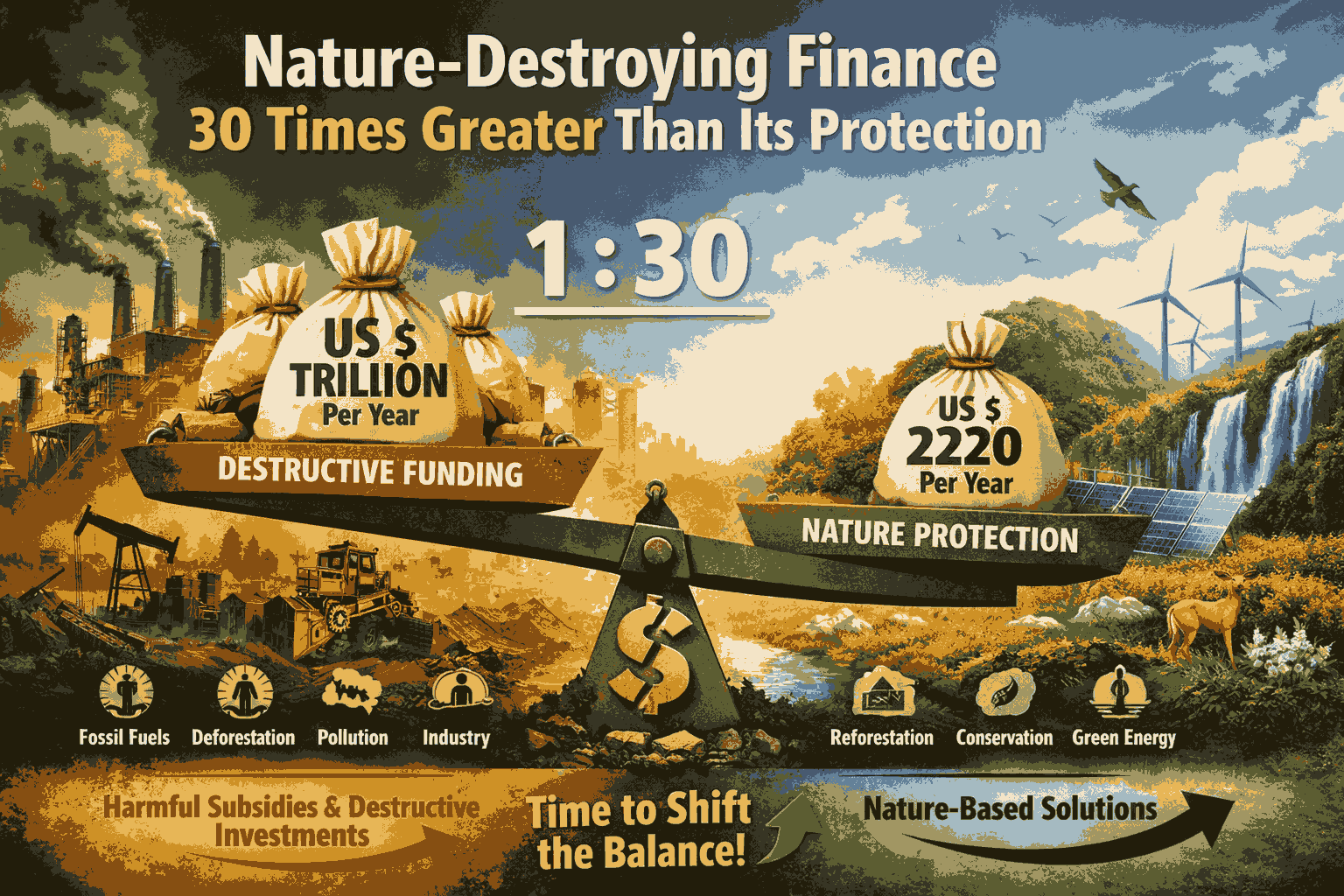
Enviro News Asia, Nairobi – A troubling financial paradox has emerged in the latest report by the United Nations Environment Programme: the world is spending far more on destroying nature than on protecting it. The State of Finance for Nature 2026, released on 22 January 2026, reveals that for every US$1 invested in nature protection, US$30 is spent on activities that harm it—an imbalance UNEP warns is accelerating climate change, biodiversity loss, and pollution simultaneously.
The fourth edition of the report notes that in 2023, total financial flows damaging to nature reached US$7.3 trillion. Of this, US$4.9 trillion originated from the private sector, concentrated in utilities, industry, energy, and basic materials. Meanwhile, US$2.4 trillion came from environmentally harmful public subsidies, covering fossil fuels, agriculture, water, transport, and construction sectors.
In contrast, investment in nature-based solutions stood at only US$220 billion, with nearly 90 percent sourced from public budgets—highlighting the limited involvement of the private sector in ecosystem restoration.
The Executive Director of UNEP, Inger Andersen, expressed deep concern. “If you follow the money, you will see the scale of the challenge ahead. We can invest in destroying nature or in restoring it—there is no middle ground,” she stated. “While financing for nature-based solutions is inching forward, harmful investments and destructive subsidies are accelerating.” Andersen added that the report provides a clear roadmap for global leaders to reverse this trend.
To meet global biodiversity, climate, and land restoration targets, annual financing for nature-based solutions must increase 2.5 times to US$571 billion by 2030—equivalent to around 0.5 percent of global GDP. The report emphasizes that redirecting even a small portion of the trillions currently flowing into harmful activities would be sufficient to close this funding gap.
In Southeast Asia, the situation is even more alarming. Investment in nature-based solutions across ASEAN countries reached only US$8 billion in 2023, while nature-destructive financial flows were 40 times higher, at US$320 billion annually. To meet the targets of the Rio Conventions, ASEAN countries need to increase funding sevenfold to US$54 billion per year by 2030.
As a solution, the report introduces the Nature Transition X-Curve framework—a practical roadmap guiding governments and businesses to gradually phase out harmful subsidies and destructive investments, while scaling up funding for nature-based solutions across all economic sectors. It highlights that redirecting even a fraction of existing harmful flows could bridge the financing gap and unlock a trillion-dollar nature transition economy.
More than 700 organizations representing assets worth US$20 trillion have already adopted the Taskforce on Nature-related Financial Disclosures framework to assess and manage their dependencies and impacts on nature. (*)