

Enviro News Asia, Jakarta — The Institute for Essential Services Reform (IESR) has supported the temporary suspension of construction of the BDx AI data center in Jatiluhur, West Java, while calling for comprehensive environmental, social and electricity-system impact assessments before the project proceeds.
The advocacy group said the suspension should be used to conduct substantive assessments rather than simply accelerate the issuance of permits. IESR also urged the government to establish national safeguards for artificial intelligence and data centers, including environmental, social and energy standards.
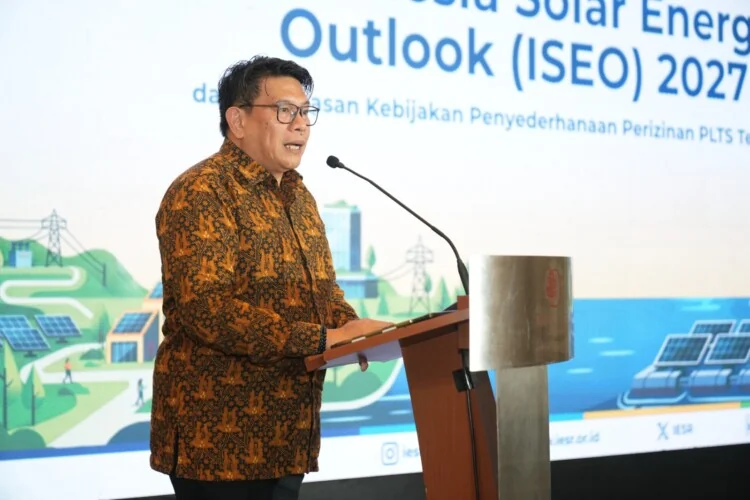
“We appreciate the firmness of the West Java governor. Data center investment is an important part of Indonesia’s digital economic growth. However, development must respect water resources, electricity reliability and the public’s right to information,” IESR Chief Executive Officer Fabby Tumiwa said.
BDx’s AI Campus 2 (CGK4) is planned with a capacity of 640 megawatts (MW) and is located about five kilometers from Jatiluhur Reservoir. The project’s groundbreaking ceremony took place on September 22, 2026.
Six days later, following a surprise inspection by West Java Governor Dedi Mulyadi on September 28, the West Java provincial government halted construction because the project had not yet obtained an Environmental Impact Assessment (AMDAL) and Building Construction Approval (PBG) from the Purwakarta Regency Government, according to IESR.
The scale of the project has raised concerns about water and electricity demand. IESR estimates that the project’s water requirement during a subsequent development phase could reach 384 liters per second, equivalent to about 33,000 cubic meters per day or more than 12 million cubic meters annually.
The water would come from Jatiluhur Reservoir, which plays an important role in irrigating agricultural land in West Java.
At full operation throughout a year, a 640 MW facility would consume up to approximately 5.6 terawatt-hours (TWh) of electricity annually, based on IESR’s calculation.
IESR called for three assessments to be made public before construction resumes.
First, it said a comprehensive AMDAL and social-environmental impact assessment should involve affected communities, including farmers who depend on the Jatiluhur irrigation system.
Second, the organization called for an assessment of the data center’s electricity demand and its potential effects on the reliability of the Java-Madura-Bali power system. The assessment should cover reserve capacity, transmission and substation requirements, and the generation sources that would supply the facility.
Third, IESR urged the government to assess potential impacts on electricity access for PLN customers, including households, micro, small and medium-sized enterprises and industries. The assessment should also identify potential supply risks and who would bear the costs of strengthening the electricity network.
“A 640 MW facility requires electricity comparable to the output of a major power plant. The public has the right to know where that electricity will come from, whether it will increase coal consumption, and whether other PLN customers will bear the risks through supply disruptions or additional network costs,” Fabby said.
IESR also argued that the Jatiluhur case highlights the need for clearer national rules as Indonesia faces growing investment in data centers and AI infrastructure.
According to figures cited by IESR, the Ministry of Communication and Digital Affairs estimated in May that Indonesia’s data center electricity demand could exceed 2 GW by 2029, while PLN has estimated that demand could reach 25 GW by 2035.
IESR called on the central government, including the Ministry of Communication and Digital Affairs, Ministry of Energy and Mineral Resources, Ministry of Environment, Ministry of Public Works and Coordinating Ministry for Economic Affairs, to establish national safeguards for data centers and AI.
Among the measures proposed by IESR are environmental, social and energy standards as requirements for data center permits; mandatory waterless or closed-loop cooling systems; a Power Usage Effectiveness (PUE) requirement below 1.3; and minimum energy-efficiency standards for information technology equipment.
IESR also proposed requiring data centers to directly use renewable energy for at least 35 percent of their electricity needs by 2030 and 50 percent by 2040. The organization said the requirement could be met through on-site renewable generation or renewable power purchase agreements rather than relying solely on certificates.
The proposal, according to IESR, would be consistent with Indonesia’s national energy policy direction under Government Regulation No. 40/2025, which sets a target for new and renewable energy to account for 36–40 percent of the national energy mix by 2040.
“Indonesia wants to become a regional data center hub. That is an opportunity, but only if the data centers are water-efficient, energy-efficient and powered by renewable energy,” Fabby said.
IESR said it was prepared to support central and local governments in developing green data center standards covering community, environmental and climate considerations. (*)