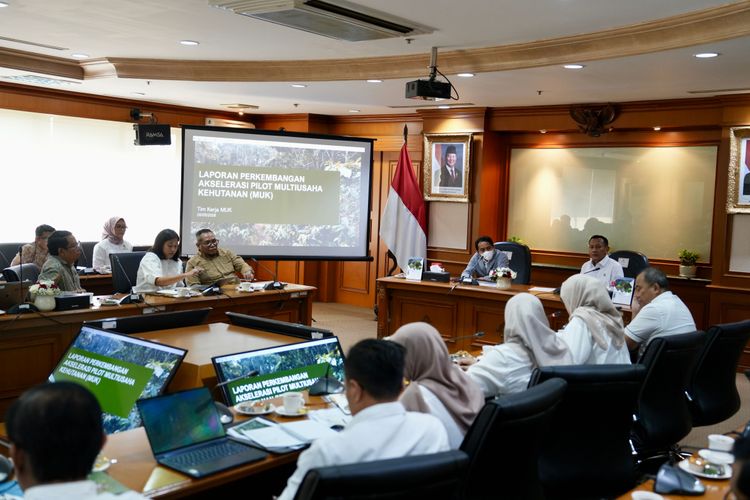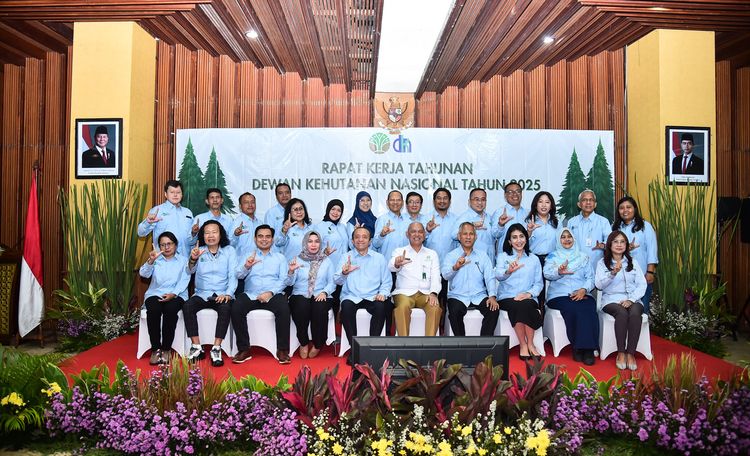
Enviro News Asia, Jakarta – The Minister of Forestry of the Republic of Indonesia, Raja Juli Antoni, represented by the Expert Staff to the Minister of Forestry for Inter-Institutional Relations, Fahrizal Fitri, officially opened the 2025 Annual Working Meeting of the National Forestry Council (DKN) in Jakarta on Tuesday (May 20, 2025).
In the speech delivered on behalf of the Minister, the importance of multi-stakeholder collaboration—especially with DKN as a strategic partner—was emphasized to drive the transformation of the forestry sector through the development and implementation of inclusive, fair, and sustainable forestry policies.
The Minister also stressed that DKN, consisting of five chambers (government, business, academia, NGOs, and community), is not merely a dialogue forum, but also acts as a co-creator in assisting the formulation and implementation of forestry policies in Indonesia.
Through this approach, the Minister hopes DKN can become a strategic partner in helping to formulate forestry policies that align with President Prabowo’s vision for forest management: forests must be sustainable, development must not be halted, and community welfare must be ensured—especially for communities living in and around forest areas.
“These three aspects must not be seen as contradictory, but rather as complementary. If we focus solely on forest sustainability without considering community welfare, inequality will widen,” said Minister Raja Juli Antoni in his speech.
On the other hand, Minister Raja Juli also warned that if development proceeds without regard for forest and environmental sustainability, its negative impacts will be borne by future generations.
“This challenge is by no means easy, but it is our shared responsibility. We must seek the best strategies so that forest management can provide optimal benefits for the environment, development, and community welfare,” the Minister stated in the official release.
In his remarks, the Minister also revealed that around 20 million hectares of degraded forest areas have been identified as strategic reserves for national energy, water, and food security. Restoring these damaged areas while adding value was described as the vision of a modern forest—productive and sustainable restoration efforts, with forests serving as a solution to national needs.
“This is the new paradigm we are promoting through the implementation of forest policies that position forests as reserves for water, energy, and food—a visionary leap to make forests a strategic reserve for national resilience,” said the Minister.
Aligned with the 2025–2029 national development agenda, the Minister outlined four forestry development priorities:
- Enhancing the forestry sector’s contribution to national economic growth.
- Optimizing forest functions as reserves for energy and water.
- Managing biodiversity by reducing ecosystem threat levels.
- Promoting downstream development of forest products such as logs, pine resin, and bioenergy from sugar palms.
To accelerate these goals, the Ministry of Forestry has formed four strategic task forces:
- Customary Forest Recognition Task Force, in collaboration with indigenous organizations and NGOs;
- Multi-Use Forestry Task Force, to encourage the integration of various forestry businesses within a single area;
- Carbon Task Force, to strengthen the forestry sector’s role in carbon trading and the green economy;
- Digitalization Task Force, responsible for improving forestry licensing systems and expanding digital services, including cashless payments and e-ticketing in conservation areas.
The Minister called on the DKN Presidium to serve as a bridge between national policies and the needs and aspirations of forestry stakeholders on the ground. Therefore, he emphasized the importance of reassessing DKN’s roles and programs to ensure synergy with future national development agendas.
In closing, the Minister expressed hope that the 2025 DKN Annual Working Meeting would produce concrete recommendations and a well-measured program mapping, supported by a strong commitment from all stakeholders to protect and utilize Indonesia’s forests for future generations. *