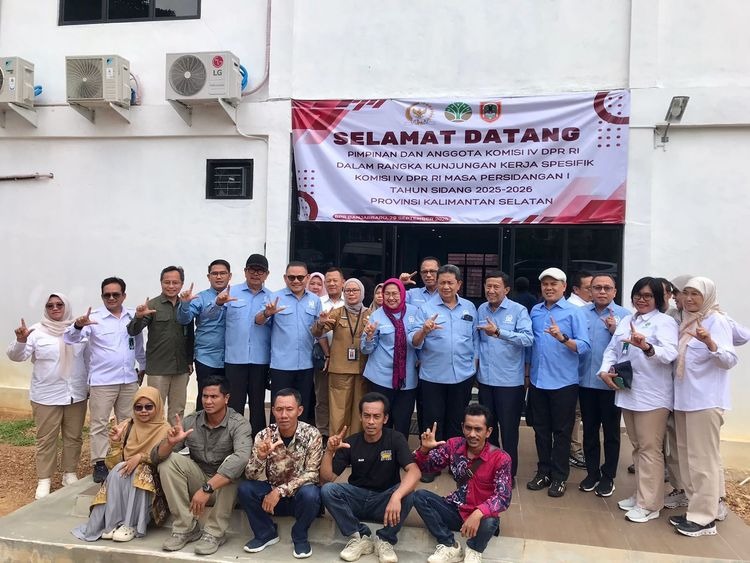
Enviro News Asia, Jakarta – Commission IV of the House of Representatives of the Republic of Indonesia (DPR RI), together with the Ministry of Forestry, conducted a Specific Working Visit to South Kalimantan Province under the theme “Downstreaming of Social Forestry Products”, Monday (September 29, 2025).
The event was attended by leaders and members of Commission IV DPR RI, the Head of the South Kalimantan Forestry Service, officials from the Ministry of Forestry, heads of Technical Implementation Units (UPT), and representatives of Social Forestry Business Groups (KUPS).
The head of the delegation, Maj. Gen. TNI (Ret.) Sturman Panjaitan, stressed that Social Forestry is a national strategic agenda that grants legal access to communities for sustainable forest management. However, according to him, access alone is not enough without strengthening downstreaming.
“Downstreaming is the golden bridge that connects upstream conservation with downstream community welfare. Social forestry products must not stop at raw sales, but need to be processed to gain added value and competitiveness,” Sturman stated during a briefing at the Banjarbaru Social Forestry Office.
Novia Widyaningtyas, Expert Staff to the Minister of Forestry for Forestry Industry Revitalization, added that the support of Commission IV DPR RI is crucial to strengthening social forestry downstreaming. She explained that by 2025 the Ministry of Forestry had granted access to manage 8.3 million hectares through more than 11,000 decrees, directly benefiting around 1.4 million households across Indonesia.
Specifically in South Kalimantan, by 2024 there were 192 Social Forestry permits covering approximately 98,188 hectares, involving thousands of families. In addition, there are 9 Indigenous Peoples (Masyarakat Hukum Adat) groups with customary territories totaling 44,784 hectares that have the potential to reinforce the program.
Downstreaming products from the program have become increasingly diverse, ranging from forest honey, palm sugar, agarwood and cinnamon essential oils, processed rattan, to ecotourism. Based on goKUPS data, the economic transaction value of social forestry in South Kalimantan from 2013–2025 reached IDR 5.03 billion from 102 business groups.
Novia further highlighted export achievements as evidence of downstreaming success. These include exports of pete and agroforestry commodities to Japan worth IDR 989 million (2024), robusta coffee to Dubai worth IDR 526 million (2025), as well as 30 tons of dammar resin to India and 15 tons of nutmeg to China with a total value of IDR 2.07 billion (2025).
“Social Forestry must become a national movement. This movement is not only about preserving forests but also about paving the way for community welfare through added value and global competitiveness,” she asserted.
During the discussion session, social forestry groups had the opportunity to voice challenges in the field, ranging from market access, financing, to technical assistance. These inputs will serve as material for follow-up by DPR RI, the central government, regional governments, and other stakeholders.
Through such synergy, downstreaming of social forestry products is expected to become a driving force for the green economy while strengthening Indonesia’s commitment to sustainable development. (*)