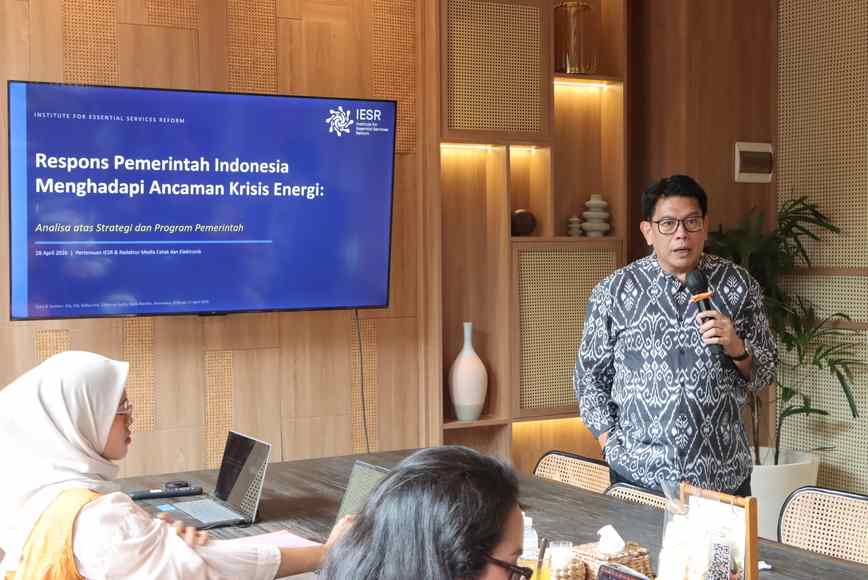
Enviro News Asia, Jakarta – Indonesia has significant potential to develop green hydrogen, with an estimated 50.7 million tons per year considered economically viable for development, according to a recent study presented by the Institute for Essential Services Reform (IESR).
The findings were presented by Rheza Hanif Risqianto, Head of Industrial Decarbonization Solutions at IESR, during the Green Energy Transition Day titled “Powering Indonesia’s Energy Transition: Scaling Renewables, Enabling Green Hydrogen.”
The study is part of the Green Energy Transition Indonesia (GETI) project, implemented by IESR in collaboration with the British Embassy Jakarta. The project is scheduled to conclude in March 2026.
Based on IESR’s analysis of around 15,800 renewable energy sites across Indonesia, the country’s total theoretical green hydrogen production potential reaches 345.6 million tons per year. However, Rheza acknowledged that most of this potential is not yet economically feasible.
According to the study, 87 percent of the locations have production costs above USD 12 per kilogram, while roughly 50 million tons per year could be produced at costs below USD 12 per kilogram, making them more viable for development.
Rheza explained that production costs vary depending on the renewable energy source and site-specific conditions. The most stable production costs were found in geothermal-based hydrogen, while the lowest potential costs could be achieved using solar and hydropower resources.
However, he emphasized that hydrogen projects cannot be determined solely by energy sources. Site-specific factors such as resource availability, infrastructure, and local conditions must also be considered.
IESR also assessed potential domestic demand for hydrogen. Under an optimistic scenario, hydrogen demand in Indonesia could reach 37.3 million tons per year, with the largest utilization expected in the power generation and maritime sectors.
To match production potential with demand, IESR conducted a spatial analysis and identified 14 hydrogen demand clusters across the country, with West Java and East Kalimantan emerging as the most prominent hubs.
West Java hosts a large concentration of industries, ports, and economic activities, where hydrogen could be used in ammonia production and potentially expanded to steel manufacturing, ceramics, shipping, and aviation sectors.
Meanwhile, East Kalimantan has a strong demand anchor due to the presence of fertilizer production facilities, creating a potential market for hydrogen-based industrial applications.
Despite its potential, Rheza noted that green hydrogen remains significantly more expensive than gray hydrogen, which is produced using fossil fuels. Electricity costs remain the primary factor influencing hydrogen production costs.
He added that reducing electricity prices by around 60 percent could lower green hydrogen prices from approximately USD 4 per kilogram to about USD 2 per kilogram.
To accelerate development, IESR recommended several policy measures, including stronger policy coordination among government agencies and the establishment of a dedicated institution to oversee green hydrogen development.
In terms of financing, the organization proposed the creation of a Green Hydrogen Fund through PT Sarana Multi Infrastruktur, along with investment support from Danantara Indonesia and the publication of a national list of potential hydrogen projects.
Responding to the study, Muhamad Alhaqurahman Isa from the Ministry of Energy and Mineral Resources of Indonesia highlighted that the National Hydrogen and Ammonia Roadmap 2060 serves as a strategic guide to develop Indonesia’s hydrogen ecosystem in alignment with national energy policy.
Meanwhile, Deni Shidqi of the Indonesia Fuel Cell and Hydrogen Energy (IFHE) noted that falling renewable electricity costs and declining prices of hydrogen conversion technologies—particularly electrolyzers—would improve the economic viability of green hydrogen.
He added that implementing carbon pricing mechanisms could further accelerate adoption by accounting for the environmental costs of fossil fuel emissions.
Saifuddin Suaib from Hydrogen de France Energy also highlighted that Indonesia’s hydrogen roadmap is unique because it includes the potential use of hydrogen as an alternative to diesel fuel.
Meanwhile, Rahmita Diansari from the Ministry of Industry of Indonesia explained that revisions to the National Industrial Development Master Plan still consider multiple hydrogen types during the transition period.
In the short term, gray and green hydrogen will continue to play roles. In the medium term, development will focus on blue and green hydrogen, while green hydrogen is expected to dominate long-term utilization. (*)