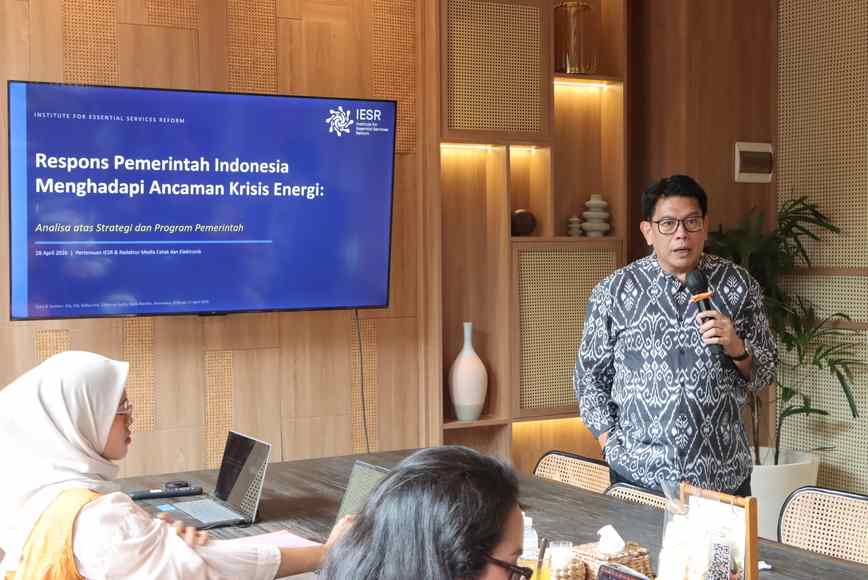
Enviro News Asia, Jakarta – The Institute for Essential Services Reform (IESR) released a media kit highlighting Indonesia’s energy subsidy posture, the risk of widening fiscal deficits due to global oil price volatility, and potential budget savings through accelerated transport electrification, while emphasizing the strategic role of green hydrogen in the country’s energy transition.
The study explains that hydrogen is expected to become a complementary solution for decarbonizing hard-to-abate sectors that are difficult to electrify directly, such as heavy industry, long-distance transportation, and high-temperature industrial processes.
According to IESR, these sectors accounted for around 20 percent of global CO₂ emissions in 2022. Because many industrial assets operate for 30 to 70 years, continued reliance on fossil fuels risks locking in long-term emissions. Low-emission hydrogen could reduce production emissions by 60–95 percent, making it a key component in achieving global net-zero emissions targets.
Among various hydrogen production pathways, green hydrogen—produced through electrolysis powered by renewable energy—offers the lowest emissions intensity, estimated at 0–0.6 kg CO₂e per kilogram of hydrogen. Other pathways face limitations, including blue hydrogen, which depends on carbon capture technology and still relies on fossil fuels, pink hydrogen from nuclear energy with unresolved regulatory and waste challenges, and grey hydrogen, which currently dominates global production but generates 11–12 kg CO₂e per kilogram of hydrogen.
IESR highlighted that Indonesia has strong comparative advantages for developing a green hydrogen ecosystem. The country possesses vast renewable energy potential—estimated at 3,687 gigawatts, though less than 0.5 percent has been utilized—along with established ammonia and fertilizer infrastructure and strategic proximity to major Asian demand centers. The national net-zero emissions target by 2060 also provides a clear policy signal for investment.
Under the national hydrogen roadmap, Indonesia aims to reach 107 gigawatts of electrolyzer capacity by 2060, while domestic hydrogen demand could grow significantly. Current demand is estimated at 1.75 million tons, primarily for fertilizer and ammonia production. The government’s roadmap projects demand to reach 11.8 million tons by 2060, while IESR’s optimistic scenario suggests demand could reach 38 million tons annually.
Demand growth is expected to occur in stages. In the short term until 2035, hydrogen could replace fossil-based hydrogen in fertilizer and refinery sectors, while ammonia co-firing in coal-fired power plants may create early demand. Between 2035 and 2045, hydrogen could support decarbonization in heavy industries such as steel and cement and begin powering long-distance logistics trucks using fuel-cell technology. By 2060, hydrogen may also be used as marine fuel, aviation fuel, and as a component in the power sector.
To support large-scale deployment, IESR recommends the development of hydrogen hubs, integrated systems that combine production, storage, transport, and end-use infrastructure in a single geographic area. This approach would help aggregate demand, reduce costs, and share risks among stakeholders.
The study identifies several priority hub locations, including East Kalimantan, particularly around the industrial corridor near the new capital Nusantara, where existing fertilizer plants, refineries, and export ports could support hydrogen development. Other potential hubs include Riau in Sumatra, with strong solar potential and export access to Singapore, and East Java, which hosts major heavy industries and well-developed logistics infrastructure.
IESR also recommends several strategic priorities for accelerating green hydrogen development in Indonesia. These include focusing on “no-regret” applications such as fertilizer and heavy industry, accelerating renewable energy deployment to reduce production costs, securing long-term industrial offtakers, developing co-located production hubs, establishing integrated regulations and a national hydrogen coordination body, providing fiscal incentives and de-risking mechanisms, and building a skilled workforce through national competency standards.
The institute emphasized that while hydrogen demand could expand significantly, not all applications must rely on domestically produced green hydrogen. Instead, each sector should undergo detailed technical and economic analysis to determine whether hydrogen or direct electrification offers the most efficient and cost-effective decarbonization pathway. (*)