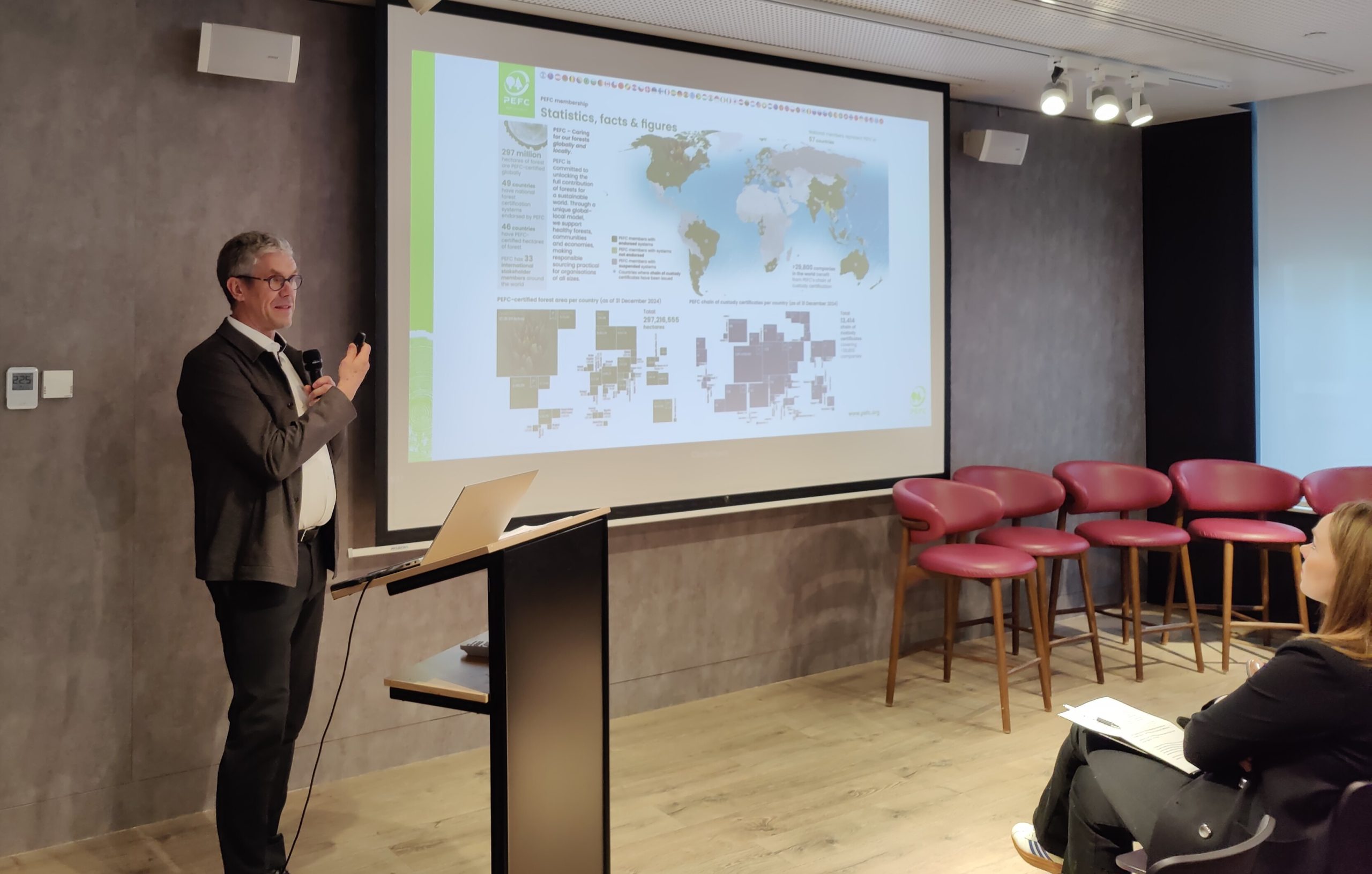
Enviro News Asia, Brussels — Policymakers, researchers, industry representatives, and civil society actors convened at a policy seminar hosted by PEFC International in Brussels to address the growing challenge of aligning climate action, economic resilience, and biodiversity protection within Europe’s forest sector.
The seminar focused on reconciling competing demands placed on forests, emphasizing that sustainable forest management must simultaneously support climate mitigation, biodiversity conservation, renewable material production, and economic development.
Opening the event, Michael Berger highlighted the need to move beyond binary perspectives, stressing that forests are expected to deliver multiple outcomes at once. He underscored that the key challenge lies in managing these roles in an integrated and practical manner.
Katri Kulmuni reinforced the strategic importance of the forest-based bioeconomy, noting its role in reducing reliance on fossil-based products and strengthening the European Union’s resource independence. She called for clear, coherent, and supportive policy frameworks to ensure long-term competitiveness and sustainability.
Research presented by Bernhard Wolfslehner demonstrated that forest governance in Europe is shaped by a complex web of approximately 570 policies spanning sectors beyond forestry, including labor, transport, and finance. He emphasized that bioeconomy and ecosystem services should not be viewed as conflicting objectives but as interconnected elements requiring careful balancing across landscapes.
The discussion highlighted that achieving multiple objectives may not always be feasible within a single area, suggesting that diversified landscape approaches could offer more effective solutions. Certification systems were identified as practical tools to translate policy goals into measurable and operational actions, ensuring consistency and accountability in forest management.
During the panel session, participants identified trust as a central challenge. Stakeholders pointed to regulatory complexity, administrative burdens, and workforce shortages as barriers to effective implementation. Industry representatives stressed the need for stable and predictable frameworks to support long-term investment, while forest owners raised concerns over increasing compliance demands.
In his closing remarks, Cillian Lohan emphasized the importance of inclusive dialogue in building trust among stakeholders. He argued that meaningful progress depends on acknowledging differences and fostering collaboration across sectors.
The seminar concluded that while there is broad agreement on the need for forests to deliver multiple benefits, stronger coordination, improved communication, and more practical policy frameworks are essential to ensure effective implementation and long-term sustainability. (*)