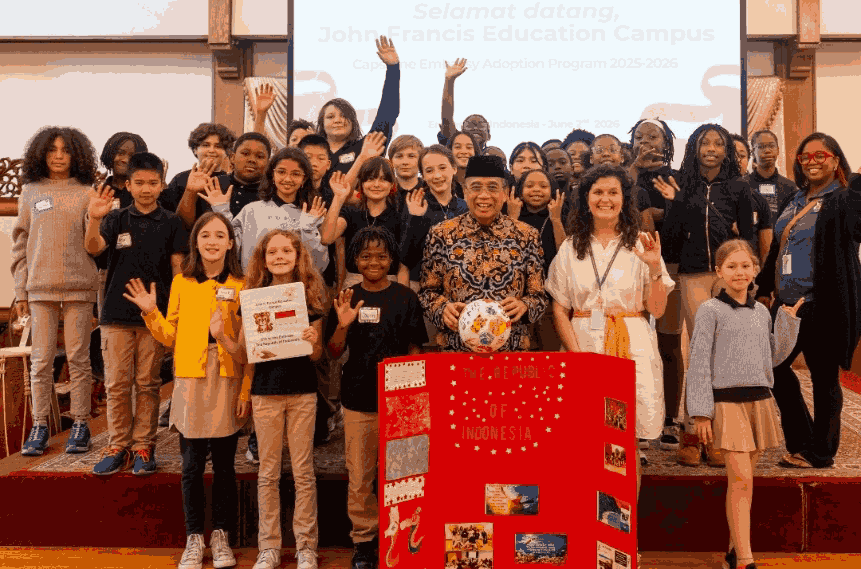
Enviro News Asia, Washington, D.C. — Indonesian culture, history, and national identity took center stage at the Indonesian Residence in Washington, D.C., as fifth-grade students from John R. Francis Education Campus showcased their knowledge of Indonesia after spending a year participating in the Embassy Adoption Program (EAP).
The event, held on 2 June 2026, featured an enthusiastic cultural presentation in which students demonstrated their understanding of Indonesia through a series of questions about the country’s geography, biodiversity, traditional arts, and national symbols.
“What is the highest mountain in Indonesia?” a teacher asked. “Mount Rinjani!” the students responded. Questions about Indonesia’s bamboo musical instrument, the Komodo dragon, and the national flower, jasmine, were answered with equal enthusiasm.
The activity marked the culmination of the Embassy Adoption Program, a long-running educational initiative established in 1974 through a partnership between the Washington, D.C. Public Schools (DCPS) and Washington Performing Arts. The program connects public school students with diplomatic missions from around the world, enabling them to learn directly about different cultures and global perspectives.
Through the year-long initiative, fifth- and sixth-grade students are “adopted” by a participating embassy and engage in a range of educational activities led by diplomats. Lessons cover language, history, culture, food, and international affairs, while diplomats and teachers jointly develop learning materials that align with school curriculum standards.
Students also participate in field trips to museums, cultural centers, and restaurants, explore traditional arts, and learn national songs from their adopted countries. One of the program’s signature activities is the Mini United Nations simulation, where students represent their assigned country and debate global issues such as climate change and disaster response.
The final Capstone Presentation serves as the program’s highlight, giving students an opportunity to present what they have learned throughout the academic year before diplomats, parents, teachers, and representatives of Washington Performing Arts.
Since its inception, the Embassy Adoption Program has connected more than 50,000 students with over 100 diplomatic missions and has received recognition from the U.S. Department of Education for excellence in international education.
The Embassy of Indonesia in Washington, D.C. has participated in the program for more than two decades. During the 2025–2026 academic year, Indonesian diplomats worked closely with students from John R. Francis Education Campus to introduce various aspects of Indonesian culture.
Among the activities was a batik workshop, where students designed and dyed their own batik patterns. Indonesian diplomats praised the students’ creativity and enthusiasm during the session, while school representatives highlighted the value of learning through artistic collaboration.
Students also visited the National Museum of Asian Art, part of the Smithsonian Institution, where they explored Indonesian artworks, viewed archival collections, and participated in dragon-themed drawing activities inspired by Asian mythology.
Indonesian Ambassador to the United States, Indroyono Soesilo, attended the Capstone Presentation and described the program as an important example of soft diplomacy and people-to-people engagement.
He expressed hope that future editions of the program could include virtual exchanges between elementary school students in Indonesia and the United States, allowing children from both countries to build friendships and cultural understanding from an early age.
According to the ambassador, advances in digital technology make such cross-border educational interactions increasingly feasible and valuable for strengthening long-term bilateral relations. (*)