

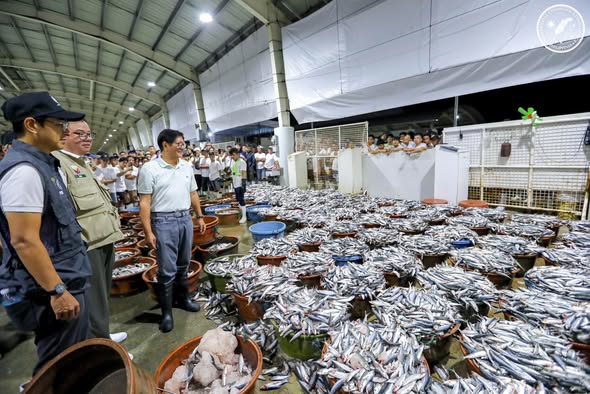
Enviro News Asia, Navotas – Philippine President Ferdinand R. Marcos Jr. on Saturday inspected the ongoing rehabilitation of the Navotas Fish Port Complex (NFPC), underscoring his commitment to modernizing the country’s premier fish port and improving its resilience to frequent flooding.
During the inspection, the President witnessed the unloading, hauling, and trading of fish products at Market 1 and toured the facility to assess its operations and ongoing improvement works, accompanied by Agriculture Secretary Francisco Tiu Laurel Jr. and Navotas City officials. Philippine Fisheries Development Authority (PFDA) General Manager Glen Pangapalan briefed the President on port operations and the ongoing rehabilitation of Markets 1 and 2.
The rehabilitation aims to address frequent flooding during high tides and typhoons while modernizing the facility to handle growing volumes of fish products and vessel operations. The project covers the rehabilitation and construction of market halls, reinforced concrete wharves, drainage and sewerage facilities, reclamation works, a shipyard, backup areas, utility facilities, and related port infrastructure.
Once completed, the project is expected to deliver safer, cleaner, more efficient, and climate-resilient facilities that improve the unloading, handling, and distribution of fish products, reduce transportation and logistics costs, preserve fish quality, minimize spoilage, and create jobs and livelihood opportunities for Navotas residents and surrounding communities.
The NFPC, whose construction began in 1974 under a loan agreement with the Asian Development Bank, was completed in 1977 and officially opened in 1979, growing into the country’s largest fish port and one of the biggest in Asia. The port’s operations have expanded in recent years, with fish unloading increasing from 196,580 metric tons in 2023 to 221,692 metric tons in 2025, and vessel arrivals rising from 24,570 to 26,128 over the same period.
The NFPC serves as a major source of fish products for Metro Manila and other parts of Luzon. (*)