

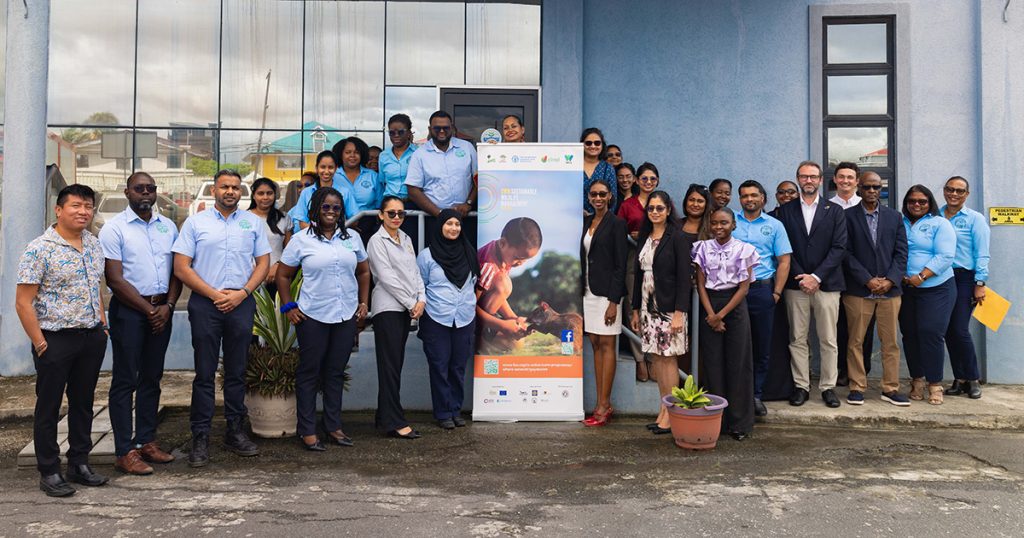
Enviro News Asia, Georgetown – Guyana has launched a new Environmental Education Curriculum (EEC) for Regions 4 and 6 while officially concluding Phase 2 of the Sustainable Wildlife Management (SWM) Programme, marking eight years of collaboration to strengthen biodiversity conservation, environmental education, and sustainable wildlife management.
The milestones were announced in Georgetown in July 2026 by the Sustainable Wildlife Management (SWM) Programme and its partners, including the Guyana Wildlife Conservation and Management Commission (GWCMC), Landscape Alliance, the Food and Agriculture Organization (FAO), and the European Union.
The initiative aims to strengthen wildlife conservation by combining biodiversity monitoring, environmental education, and community participation. The newly introduced curriculum is designed to equip students with environmental knowledge and promote responsible stewardship of Guyana’s natural resources, while the SWM Programme has supported sustainable wildlife management through science-based conservation and local partnerships.
According to SWM Programme Country Coordinator Oswin David, the eight-year initiative has demonstrated how conservation and human development can be balanced through long-term collaboration. GWCMC Commissioner Alona Sankar added that the programme has strengthened national wildlife management and biodiversity monitoring, particularly following the addition of its biodiversity component in 2024.
The biodiversity programme has engaged seven villages across the Rupununi region to evaluate six monitoring approaches, including camera trapping, passive acoustic monitoring, bird surveys, environmental DNA (eDNA), local ecological knowledge, and fish stock assessments. More than 700 species have been documented, while researchers have developed an artificial intelligence model capable of identifying 445 species classes, creating one of the region’s largest biodiversity identification databases.
The Environmental Education Curriculum, originally developed by the South Rupununi Conservation Society for Region 9, has now been expanded to Regions 4 and 6. Director of the National Center of Educational Resources Development (NCERD), Omwaittie Ramdin, said the curriculum represents an investment in future generations by providing students with the knowledge, values, and skills needed to protect Guyana’s natural environment.
Following the completion of Phase 2, partners will continue supporting biodiversity monitoring, expand implementation of the environmental curriculum, and advance the National Biodiversity Monitoring Initiative to strengthen long-term conservation and sustainable development across Guyana. (*)