Enviro News Asia, Lampung — The Asosiasi Pengusaha Hutan Indonesia (APHI) strengthened collaboration with academics to accelerate the development of Multi-Business Forestry (MUK) in Lampung Province in an effort to increase the added value of forest areas and strengthen the forestry sector’s contribution to the national economy.
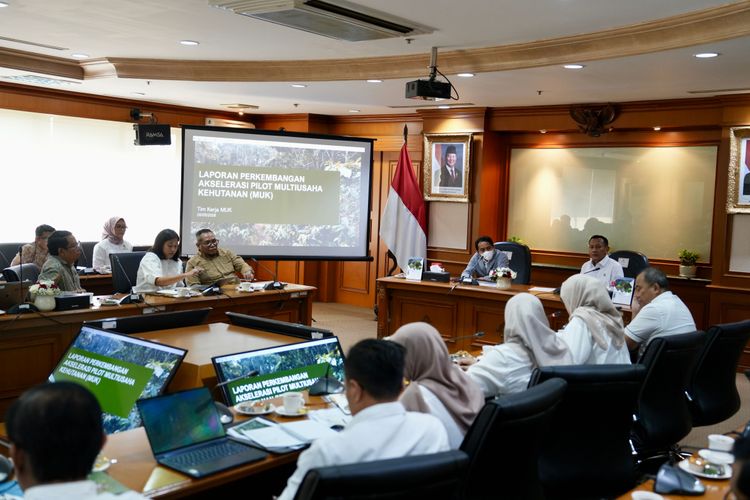
The commitment emerged during a meeting between APHI Chairman Soewarso and Dean of the Faculty of Agriculture at the Universitas Lampung, Kuswanta Futas Hidayat, in Bandar Lampung on Thursday (March 5). The discussion focused on potential cooperation in research development, site-based management models, and the establishment of pilot projects for Multi-Business Forestry in Lampung’s forest landscapes.
Soewarso emphasized that developing Multi-Business Forestry requires close collaboration between the private sector, government institutions, and academia to ensure measurable implementation and broader economic impact.
He explained that Multi-Business Forestry practices have already been implemented in several forest areas in Lampung, providing valuable experience to develop more integrated and sustainable MUK models at the landscape level.
According to Soewarso, Lampung has several advantages that support the acceleration of MUK development. These include fertile and relatively flat land conditions, adequate infrastructure and accessibility, experienced human resources in forestry and agricultural commodities, and strong support from the regional government.
With these advantages, APHI plans to focus the development of MUK in Lampung on strengthening business governance in line with the principles of Sustainable Forest Management (SFM). The initiative will also reinforce administrative management and supply chains from upstream production to downstream markets by improving production factors such as quantity, quality, and continuity.
He added that developing demonstration plots or pilot projects will be crucial as a shared learning platform for stakeholders to design forest business models that align with the specific characteristics of Lampung’s landscapes.
Meanwhile, Kuswanta Futas Hidayat welcomed APHI’s initiative to collaborate with universities in accelerating the implementation of Multi-Business Forestry in the region.
He noted that Lampung has several promising commodities that could support the development of MUK, including coffee, cocoa, candlenut, and nutmeg. These commodities, he said, have strong potential to be developed through integrated forest-based economic activities.
Kuswanta also highlighted that pilot projects could be implemented in several potential areas, including forest landscapes and integrated regional development zones that already have a foundation for local economic growth.
In addition, Lampung has significant potential in non-timber forest products (NTFPs), particularly coffee. According to Kuswanta, approximately 60 percent of Lampung’s coffee production originates from forest areas, indicating strong potential for further development through sustainable forest management approaches.
He added that the Forestry Department of the Faculty of Agriculture at Universitas Lampung has several research fields relevant to supporting MUK development, including social forestry and forestry science and technology. These fields can contribute to strengthening community-based forest governance and promoting innovation in forest management.
The collaboration between APHI and Universitas Lampung is expected to integrate academic research with field implementation in developing regional commodity-based Multi-Business Forestry models, while promoting productive, inclusive, and sustainable forest management that benefits local communities and regional economies. (*)