


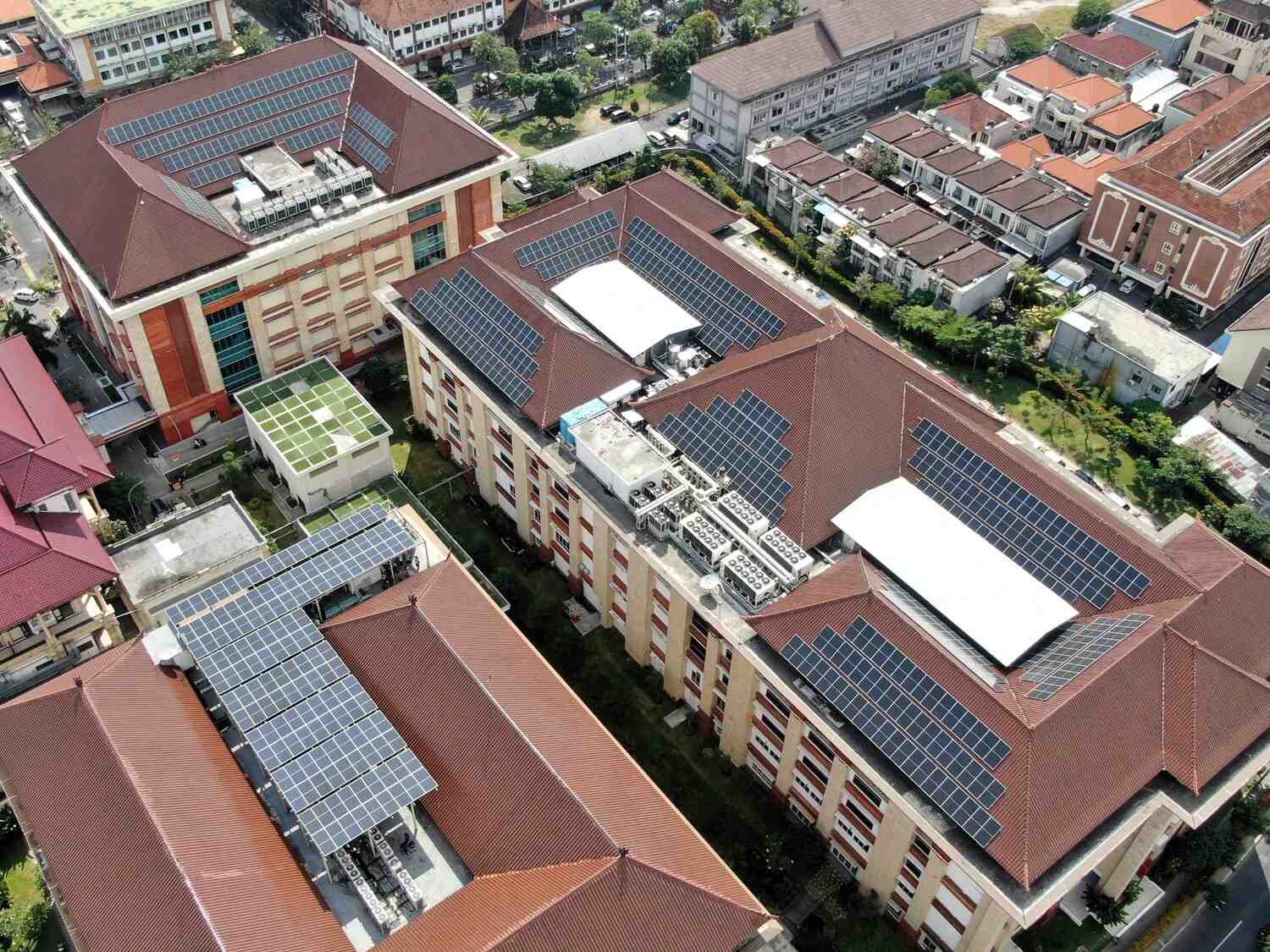
Enviro News Asia, Denpasar – NgoerahSun Wellness & Aesthetic Center (NSWAC) in Bali is demonstrating how solar energy can support sustainable healthcare by reducing electricity costs, lowering carbon emissions, and improving energy reliability through a large-scale rooftop solar power system.
The facility was one of three sites visited during the Energy Tour organized by the Institute for Essential Services Reform (IESR) as part of the Indonesia Solar Summit (ISS) 2026 on July 16. Participants included representatives from the Coordinating Ministry for Economic Affairs and provincial agencies responsible for industry, trade, energy, and mineral resources from Central Java, West Nusa Tenggara, Jakarta, and Riau.
Operating since 2025 under Prof. Dr. I.G.N.G. Ngoerah Central General Hospital, NSWAC has incorporated renewable energy into its operations through a 378.7-kilowatt peak (kWp) rooftop solar photovoltaic (PV) system installed across three main buildings. The system comprises 696 solar panels, including 221.4 kWp on the Maternal and Child Health Building, 74.8 kWp on the Outpatient Building, and 82.5 kWp on the NSWAC building.
IESR Director for Climate and Just Energy Transition Agus Praditya Tampubolon said the facility offers a practical example that regional governments can replicate to accelerate solar energy adoption across Indonesia.
NSWAC Administration and Household Manager I Wayan Eka Suardika said the hospital aims not only to become a leading healthcare provider in the Asia-Pacific region but also to promote sustainable medical tourism. He noted that installing rooftop solar panels is an important component of the hospital’s green hospital strategy.
According to Putu Eka Suputra, Head of Hospital Facilities Maintenance, the solar power system operates under an on-grid configuration connected to the national electricity network operated by PLN.
He explained that Bali’s high solar radiation throughout the year, combined with the hospital’s significant daytime electricity demand, makes solar energy particularly suitable for the facility.
The three solar installations are expected to generate between 1,450 and 1,750 kilowatt-hours (kWh) of electricity per day, supplying more than 16 percent of the hospital’s total electricity consumption. The system also helps stabilize the hospital’s internal power supply, reducing the risk of damage to sensitive medical equipment caused by electrical load fluctuations.
To further improve energy efficiency, the hospital has installed 30 solar-powered street lighting units, each with a capacity of 200 Watt-peak (Wp), around the hospital complex, reducing electricity consumption for outdoor lighting.
Despite these achievements, the hospital faces challenges in expanding its solar capacity due to limited rooftop space occupied by chillers, ventilation systems, and hot water pipelines. Careful panel placement is required to minimize shading and maintain optimal electricity generation.
Looking ahead, NSWAC plans to increase its rooftop solar capacity by utilizing new building rooftops and developing solar carports. The hospital also intends to integrate a Battery Energy Storage System (BESS) to store excess daytime electricity for emergency backup in critical facilities such as operating rooms and intensive care units, while implementing a smart energy management system and expanding the use of solar-powered street lighting. (*)