

Enviro News Asia, Jakarta — Community empowerment is the most crucial element in improving the effectiveness of forest and land fire (karhutla) prevention efforts in Indonesia. The governance of forest and land fire prevention cannot rely solely on central government policies but requires close collaboration among actors at the local level and the use of more precise communication approaches.
This was one of the key ideas presented in the dissertation of Trisia Megawati Kusuma Dewi during the Open Doctoral Examination in Environmental Science at the Postgraduate School of Sustainable Development, Universitas Indonesia, held at the Universitas Indonesia Salemba Campus on Saturday (22/11/2025). The dissertation, titled Environmental Communication Model in Forest and Land Fire Prevention, was examined under the leadership of Dwi Dono Martono with Herdis Herdiansyah as the Promoter, and Tri Budhi Edhi Soesilo and Anter Venus as Co-Promoters.
In her research, the doctoral candidate found that the Central Government, the Ministry of Environment and Forestry, remain the primary actors in directing policies for forest and land fire risk management. However, the effectiveness of these policies is often hindered by a lack of synchronized coordination on the ground. Within this context, community empowerment—particularly through partnerships with private-sector actors—becomes a strategic leverage point for strengthening village capacity, shaping new norms, and driving preventive behavior change.
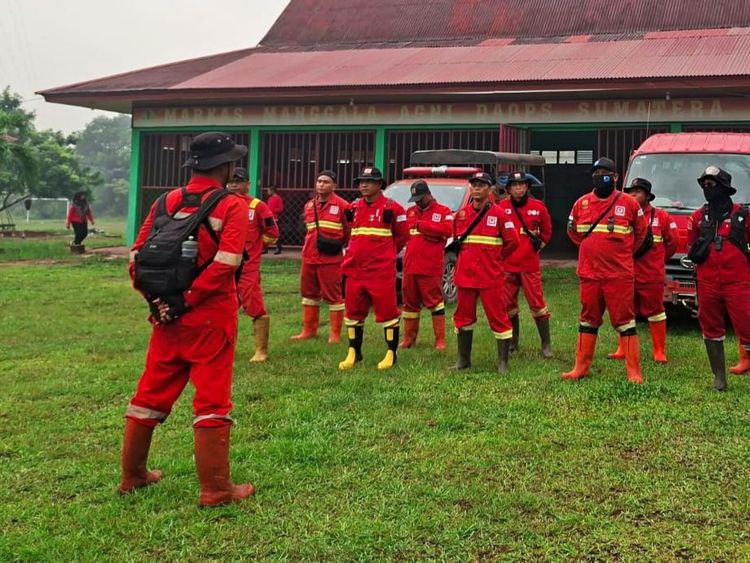
At the operational level, according to Trisia, Manggala Agni plays an important role as a liaison across governance levels. However, the research notes that their effectiveness is still constrained by weak coordination and communication among stakeholders. “This condition highlights the need for more structured multi-stakeholder collaboration to consolidate knowledge and strengthen village capacity, particularly to support the achievement of the FOLU Net Sink 2030 target,” Trisia said in her presentation.
Another finding from the research shows that environmental communication strategies cannot be standardized for all groups. Analysis of farmer behavioral patterns—including territorial map accuracy and socio-ecological variables such as gender, attitudes, land ownership, and land distance—reveals that messages must be tailored to the characteristics of each group. Strengthening group norms and efficacy becomes crucial for ensuring that preventive behavior change occurs more effectively and sustainably.
Operational Recommendations
Based on her research, Trisia Megawati provided several operational recommendations for improving forest and land fire prevention governance. First, the Central Government and the Ministry of Environment and Forestry need to strengthen meta-governance by enhancing more binding cross-actor coordination at the local level. Community empowerment in partnership with private-sector actors must be made a core strategy to ensure synchronized actions and strengthened community capacity.
Second, the role of Manggala Agni must be strengthened through more structured communication and coordination mechanisms, as well as permanent multi-stakeholder collaboration platforms to reinforce adaptive responses on the ground and support the FOLU Net Sink 2030 target.
Third, fire prevention communication strategies should prioritize weak fear appeal approaches aligned with group norms and farmers’ social identities, while strengthening efficacy and intention to act. “This approach is essential to integrate into community empowerment programs through regulation to stimulate collective behavior change,” Trisia told examiners Donna Asteria, Agus Justianto, Soewarso, Mahawan Karuniasa, and Dwisuryo Indroyono Soesilo.
Fourth, environmental communication models should utilize territorial maps and biplot analysis as the basis for segmentation so that messages align more closely with farmers’ socio-ecological characteristics.
For future research, Trisia identified the need for deeper exploration of media narratives regarding forest and land fires, which tend to focus on short-term impacts. This tendency may reduce attention to long-term prevention efforts. She also emphasized the importance of comparative studies between farmers participating in community empowerment programs such as Fire-Aware Independent Villages (DMPA) and those who are not, to understand differences in attitudes and preventive behavior.
Trisia further highlighted the need for comparative studies between farmers in peatland and non-peatland areas with a larger number of respondents. This step is essential to obtain a more comprehensive understanding of forest and land fire prevention behavior. “It is also crucial to reconceptualize the role of the media in environmental communication so that it better supports forest and land fire prevention efforts,” she stressed.
Through these findings and recommendations, Trisia Megawati’s research underscores that successful forest and land fire prevention depends not only on technical policies and enforcement but also on active community involvement and targeted communication strategies. Coordinated multi-stakeholder efforts remain the primary pathway toward more effective and sustainable fire-risk management. (*)