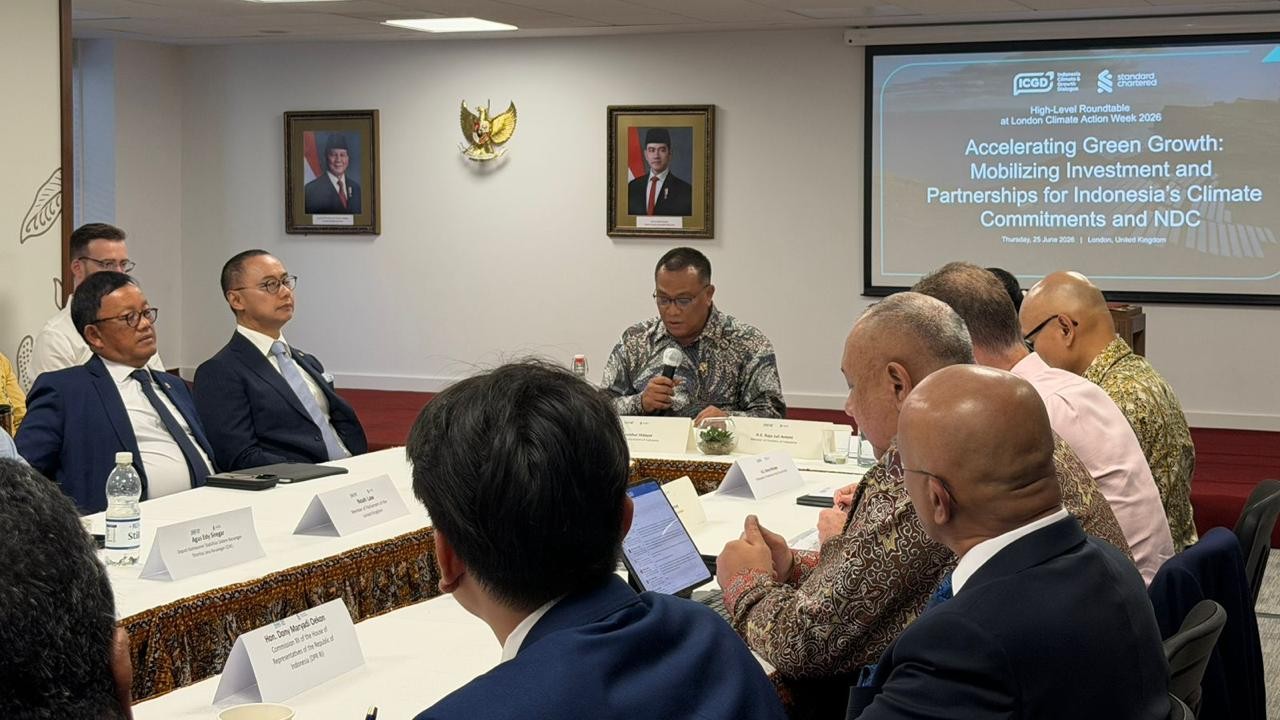
Enviro News Asia, London – Minister of Environment/Head of the Environmental Control Agency (KLH/BPLH) Moh. Jumhur Hidayat has asserted that environmental conservation is the primary foundation for achieving Indonesia’s national economic growth target of eight percent, making the case for green investment at the high-level Accelerating Green Growth forum during London Climate Action Week 2026 to address a national climate funding gap exceeding US$281 billion.
Speaking at the forum initiated by the Indonesia Climate and Growth Dialogue (ICGD), Standard Chartered Bank, and the British Embassy in London, Jumhur explained that the current state budget allocation can only cover around 18 percent of total climate action funding needs, making global participation in strengthening that financing essential.
“Environmental protection is not an obstacle to development. On the contrary, a well-protected environment is the foundation that makes Indonesia’s eight percent economic growth achievable on a sustainable basis,” Minister Jumhur said before policymakers, financial institutions, and international investors.
To ensure investment flows align with sustainable development targets, the government has set strict criteria. “That is why we need the participation of the business world and international partners to strengthen green investment. However, the investment coming in must deliver real benefits for environmental protection while supporting economic development,” he said.
As the environmental control authority, KLH/BPLH has prepared strategic governance instruments to ensure economic momentum is aligned with climate action. One concrete step is the implementation of the Subnational Nationally Determined Contribution (Subnational NDC) Roadmap, which distributes emission reduction obligations across Indonesia’s 38 provinces based on each region’s characteristics and capacity.
“Every region has different potential and challenges. Through this target distribution, regional governments have clearer responsibilities while emission reduction achievements can be monitored and evaluated in a measurable manner,” Jumhur explained.
In parallel with mitigation steps, the government is also implementing the National Adaptation Plan (NAP) 2026–2030, designed to ensure the resilience of infrastructure, food systems, and community welfare against the impacts of climate change.
“This is not merely an environmental agenda. Adaptation is an investment to protect infrastructure, the agricultural sector, and communities from the risk of climate-related disasters,” the Minister said.
On the international trade front, Jumhur noted that sustainability is now a mandatory requirement in global commerce, including through the UK Carbon Border Adjustment Mechanism (UK-CBAM) set to take effect in 2027. He described Indonesia’s strong domestic environmental governance as a strategic asset rather than a constraint.
“We view these developments in global policy as an opportunity to improve the competitiveness of Indonesian products. With increasingly strong environmental standards, Indonesian products will be better positioned to compete in international markets,” he said.
Closing his presentation, Jumhur stressed that achieving economic growth through a green pathway requires multi-party synergy, calling for collaboration among government, businesses, financial institutions, academics, and communities to ensure the green economy transition creates jobs, strengthens national competitiveness, and delivers real benefits for the people. (*)