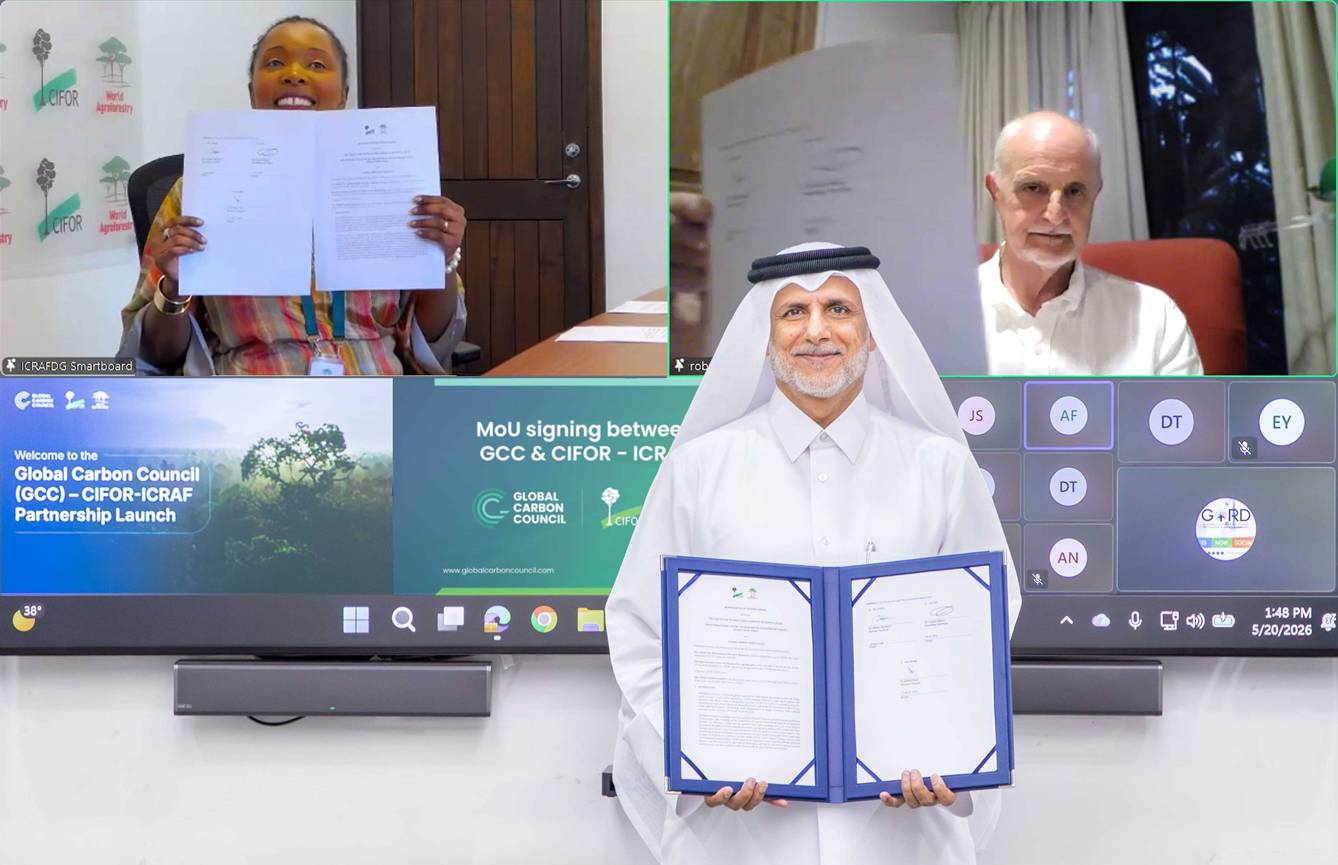
Enviro News Asia, Doha — The Global Carbon Council (GCC) and CIFOR-ICRAF have signed a Memorandum of Understanding (MoU) aimed at accelerating high-integrity nature-based climate solutions and strengthening environmental credibility in global carbon markets.
The partnership combines GCC’s expertise in carbon crediting standards with CIFOR-ICRAF’s scientific research capabilities in forestry, agroforestry, and landscape restoration. The collaboration comes as the world faces a widening imbalance in environmental finance, with investments that harm nature continuing to far exceed funding for nature-positive initiatives.
According to the 2026 State of Finance for Nature report by the United Nations Environment Programme, global financing for activities that damage nature reached approximately US$7.3 trillion in 2023, compared with only US$220 billion directed toward nature-based solutions. The gap means that for every dollar invested in protecting ecosystems, roughly thirty dollars continue to support activities that degrade the environment.
The new alliance seeks to help redirect financial flows toward climate and biodiversity solutions by strengthening the scientific foundations and transparency of carbon market projects. GCC recently received approval from the Integrity Council for the Voluntary Carbon Market, enhancing the credibility of its carbon crediting framework.
GCC Founding Chairman Yousef Alhorr said the collaboration is intended to provide the technical assurance needed for governments and private investors to support nature-based climate projects with confidence.
“The core objective of our partnership with CIFOR-ICRAF is to build the transparency and technical assurance essential for both public and private sectors to invest confidently in the planet’s natural capital,” Alhorr said. He added that the initiative would support the development of high-integrity methodologies tailored to the ecological and social conditions of the Middle East and North Africa (MENA) region while contributing to the objectives of the Paris Agreement.
Meanwhile, Eliane Ubalijoro emphasized the importance of elevating scientific expertise and climate solutions originating from the Global South.
“This collaboration underscores the importance of elevating science and solutions from the Global South in shaping the future of carbon markets,” Ubalijoro said. She noted that stronger scientific evidence and locally grounded approaches can help deliver more equitable and effective climate outcomes for communities and ecosystems.
Under the agreement, both organizations will work together on policy dialogue, technical assistance, capacity building, and international outreach related to nature-based solutions, climate finance, and carbon market participation. The partnership will support governments, project developers, and businesses in navigating both voluntary and compliance carbon markets while improving methodologies for monitoring and measuring climate impacts.
A key priority will be expanding nature-based solutions in regions where climate vulnerability intersects with development challenges. The collaboration will focus on identifying and scaling mitigation activities that generate both environmental and socio-economic benefits while maintaining rigorous scientific standards.
The partners will also exchange data, research findings, and technical expertise to strengthen baseline and monitoring methodologies for carbon projects. Particular attention will be given to ecosystems such as forests, peatlands, mangroves, and coastal wetlands, which play a critical role in climate mitigation and adaptation.
CIFOR-ICRAF’s work spans more than 90 countries and promotes integrated landscape approaches, including zero-deforestation agroforestry, ecosystem restoration, sustainable food systems, biodiversity conservation, and climate resilience. Through the new partnership, both organizations aim to accelerate the deployment of scalable climate solutions that support local livelihoods while contributing to global climate goals. (*)