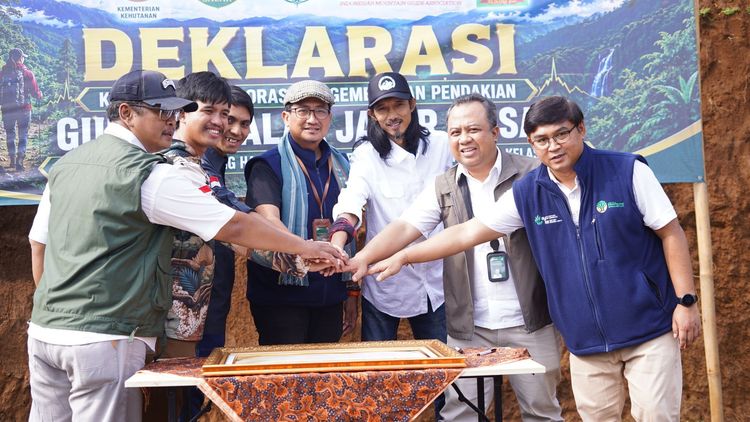
Enviro News Asia, Bogor — The Secretariat General of the Ministry of Forestry carried out the activity titled “Strong Synergy of the Secretariat General: Carbon Footprint Compensation Tree Planting” in Rumpin, Bogor, on Thursday (14/11/2025). This initiative represents a concrete step by the Secretariat General in supporting sustainability efforts, climate change mitigation, and compensation for the carbon footprint generated by institutional activities.
Secretary General of the Ministry of Forestry, Mahfudz, emphasized that tree planting is a tangible contribution of the institution toward national and global agendas on carbon neutrality.
“Tree planting is not merely symbolic; it is a real action that reflects our responsibility to the environment. The trees we plant will become nature’s shield against climate change and a legacy for future generations,” Mahfudz stated.
He added that the activity also supports the FOLU Net Sink 2030 target, in which the forestry sector is expected to become a net carbon sink by 2030.
“This strong synergy is something we build and internalize as a real contribution to supporting the Ministry’s performance, including the implementation of emission reduction commitments,” he noted.
During the same occasion, Head of the Center for the Development of Forestry Hydrometeorological Disaster Mitigation and Adaptation, Wening Sri Wulandari, presented the Ministry’s 2024 carbon footprint assessment. The total carbon footprint amounted to 15,981 tons CO₂e, comprising 5.2% direct emissions from fuel (Scope 1), 85.5% from electricity use (Scope 2), and 9.3% from business travel and employee transportation (Scope 3).
According to Wening, the calculation is a follow-up to the Minister’s directive and was carried out in accordance with Minister of Forestry Decree Number 59 of 2025. The assessment for central offices has been completed, while the process for Technical Implementation Units (UPT) is still ongoing.
During the planting event, 900 seedlings of Multi-Purpose Tree Species (MPTS) with ecological, economic, and social value were prepared. The planting was symbolically conducted by the Secretary General, the Minister’s Expert Staff, and representatives from units within the Secretariat General.
“This activity is a collective action and a symbol of strong synergy across the Secretariat General in integrating carbon management into organizational operations,” Wening said.
Concluding the event, Mahfudz encouraged all staff to continue making carbon compensation planting a sustainable institutional culture.
“Let us make this moment a collective effort to protect the Earth. With strong synergy, our forests remain sustainable, nature improves, and the people prosper,” he remarked. (*)