By: Sugijanto Soewadi
(Carbon Project Practitioner)
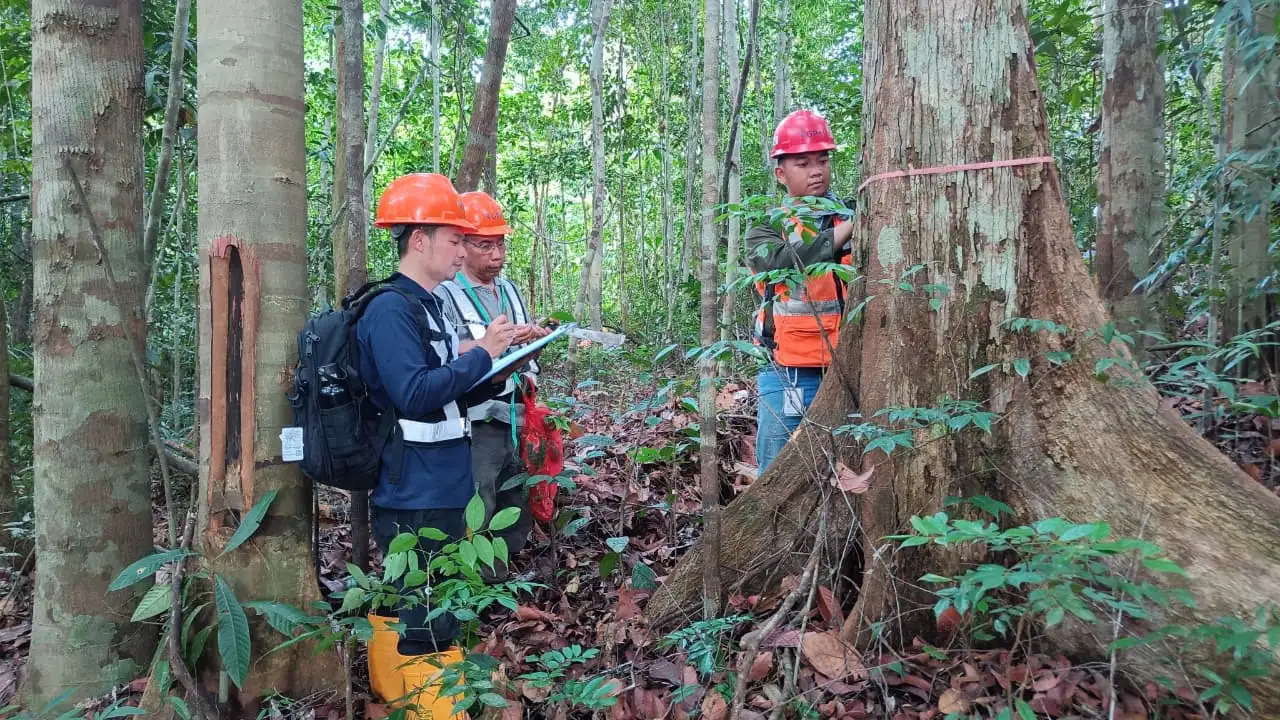
Social Forestry (SF) is one of Indonesia’s strategic policy instruments that places local communities as the primary actors in forest management. The national target for Social Forestry is 12.7 million hectares. As of early 2025, implementation has reached approximately 8.32 million hectares, involving more than 1.3–1.4 million households and thousands of ministerial decrees. The program focuses on improving the social and economic welfare of forest-dependent communities while promoting sustainable forest management through schemes such as Village Forests, Community Forests, Customary Forests, Community Plantation Forests, and Forestry Partnerships.
Amid the rapid development of national and global carbon markets, a critical question emerges: do Social Forestry areas have the same opportunities as other forest utilization permits—many of which are significantly larger in scale and were granted much earlier by the government—in relation to the forest carbon business, which has recently become a new global trend?
This article examines that question through four key indicators: (1) land area feasibility, (2) sources of financing, (3) potential off-takers, and (4) carbon methodologies or schemes.
Why is Social Forestry relevant to the carbon business?
The carbon business is essentially an economic incentive for environmental performance, closely linked to global collective action over the medium to long term in addressing climate change. In this context, Social Forestry fulfills critical prerequisites for carbon projects, particularly the availability of long-term management rights. Social Forestry permits—granted for 35 years and extendable—provide the certainty required for multi-decade carbon projects.
Moreover, Social Forestry activities are grounded in tangible mitigation actions. Practices such as agroforestry, land rehabilitation, forest protection, and sustainable forest management are directly associated with carbon sequestration and/or emission avoidance (avoided deforestation and forest degradation).
Carbon markets—especially buyers with strong Environmental, Social, and Governance (ESG) orientations—increasingly value projects that deliver social co-benefits, including poverty reduction, strengthened local institutions, and gender inclusion. All of these attributes are inherent to Social Forestry. Consequently, Social Forestry carries strong potential to advance social justice, which can serve as an added value within community-based forest carbon project platforms.
Economically viable land area within Social Forestry
The primary challenge facing Social Forestry in relation to forest carbon business opportunities is land fragmentation. Many Social Forestry permits cover relatively small areas, ranging from tens to hundreds of hectares. As a result, achieving economic viability requires aggregation and landscape-level approaches, rather than relying on individual permits.
Mitigation actions with strong potential for carbon trading include planting and rehabilitation activities, particularly ARR (Afforestation, Reforestation, and Revegetation) through agroforestry. Several Social Forestry schemes are well suited to this approach, including Community Plantation Forests (HTR), Community Forests (HKm), and parts of Village Forests, where degraded or open lands are commonly found. While projects can technically begin at scales of tens or hundreds of hectares, economic feasibility is more realistically achieved by consolidating areas into at least 500–1,000 hectares. This can be done by integrating multiple Social Forestry permits into a single landscape-level program, for example through cooperatives or associations of Social Forestry Business Groups (KUPS).
Other mitigation actions with strong potential—particularly where forest conditions remain relatively intact—include forest protection schemes such as REDD+ (Reducing Emissions from Deforestation and Forest Degradation) and Improved Forest Management (IFM). These are applicable in Village Forests, Customary Forests, and Forestry Partnerships. Such schemes generally require areas ranging from several thousand to tens of thousands of hectares to be economically viable. Therefore, they are most realistically implemented through clusters of Social Forestry areas within a district, or through landscape or jurisdictional approaches that may involve local governments.
In many cases, Social Forestry projects are rarely viable as standalone carbon projects, but they become highly feasible when designed collectively—albeit with greater complexity and higher coordination challenges.
Sources of financing accessible to Social Forestry
Carbon credits cannot be sold immediately at the outset. Accordingly, Social Forestry requires transitional financing to bridge the preparation phase to the credit issuance phase.
First, state and public financing can be accessed through Social Forestry funds managed by public service agencies or relevant ministries. These funds may be used to strengthen Social Forestry business groups, support rehabilitation, and promote agroforestry—while simultaneously laying the foundation for carbon projects. Additional public financing may come from the Environmental Fund Management Agency, given the relevance of such projects to performance-based REDD+ mechanisms and community-based mitigation programs.
Second, grants and international climate finance represent important sources of support. These include multilateral funds such as the Green Climate Fund (GCF), which operates under the UNFCCC and finances mitigation and adaptation projects in developing countries, as well as the Forest Carbon Partnership Facility (FCPF) of the World Bank, which supports REDD+ readiness and results-based payments. Bilateral donors may also contribute. While these entities typically do not purchase carbon credits directly from small community groups, they often finance enabling activities such as Measurement, Reporting, and Verification (MRV), institutional strengthening, and benefit-sharing mechanisms.
Third, private and philanthropic financing may be mobilized. This can include corporate social responsibility (CSR) funding from companies seeking positive reputational impacts and strengthened corporate branding. For example, such funding may support early-stage activities—nurseries, planting, and technical assistance—in exchange for future rights to a portion of carbon credits. Blended finance structures are also possible, combining public funds, grants, and commitments from future carbon off-takers within a single financing framework.
Who are the potential carbon off-takers for Social Forestry?
Several categories of buyers have the potential to purchase forest carbon credits generated through Social Forestry projects.
First, the domestic market, particularly Indonesian corporations in sectors such as banking, energy, mining, manufacturing, and transportation. These entities increasingly require carbon credits to meet emission reduction targets and are becoming more sensitive to social and reputational considerations. Social Forestry projects offer strong narrative advantages, combining climate mitigation with community empowerment and the reduction of tenure-related conflicts.
For financial institutions, carbon purchases are not merely offsets, but instruments of ESG compliance and reputational enhancement. Social Forestry can provide moral legitimacy and a dimension of social justice. In extractive industries such as mining, Social Forestry strengthens ESG packages that integrate carbon mitigation, ecological restoration, and community development. Manufacturing companies, fast-moving consumer goods (FMCG) producers, and global supply chains represent particularly promising markets, as Social Forestry carbon credits can enhance corporate reputation, social narratives, and value-based positioning. Government programs and jurisdictional results-based payment (RBP) schemes linked to nationally determined contributions (NDCs) may also serve as viable market orientations for Social Forestry carbon, offering long-term security even if price levels are relatively moderate.
Second, the international market. Global carbon buyers generally seek high-integrity credits, community-based projects, and compelling impact narratives. They also typically require globally recognized methodologies, rigorous MRV systems, and clear rights and benefit-sharing arrangements.
Importantly, Social Forestry carbon is best positioned as premium community-based carbon, rather than low-cost credits. Carbon prices are strongly influenced by project type (ARR or REDD+), MRV integrity, scale, contract duration, and project reputation. Due to its ethical and social values, Social Forestry tends to fall within the mid-range to premium price categories.
Below is an indicative and realistic carbon price range by sector for the current Indonesian context, distinguishing between domestic markets (including compliance mechanisms and the national carbon exchange) and voluntary carbon markets. These figures represent practical negotiation ranges rather than fixed prices.
Indicative Carbon Price Ranges
| Sector | Price Range (USD/tCO₂e) | Price Class | Suitability for SF |
| Banking | 8 – 15 | Medium | ⭐⭐⭐⭐ |
| Energy | 4 – 8 | Low | ⭐⭐⭐ |
| Mining | 6 – 12 | Medium | ⭐⭐⭐⭐ |
| Manufacturing / FMCG | 10 – 25+ | Premium | ⭐⭐⭐⭐⭐ |
| Aviation & Tourism | 12 – 30 | Premium | ⭐⭐⭐⭐ |
| Jurisdictional REDD+ | 5 – 10 | Medium | ⭐⭐⭐ |
Carbon methodologies suitable for Social Forestry
The government is currently developing a national carbon registry standard while also engaging in mutual recognition arrangements with five international voluntary standards: Verra, Puro Earth, Gold Standard, Global Carbon Council, and Plan Vivo. Although all serve as carbon accounting standards, each has distinct strengths and varying degrees of suitability depending on project characteristics.
Several methodological options are particularly relevant for forest carbon projects under Social Forestry:
- ARR and Agroforestry
The most popular and relatively accessible option for Social Forestry. Activities include tree planting, mixed gardens, and silvopastoral systems. Advantages include strong community participation, ease of understanding for group members, and direct economic co-benefits. - Improved Forest Management (IFM)
Suitable for Village Forests and Customary Forests with relatively good forest cover. Carbon accounting focuses on reducing illegal logging and implementing sustainable forest management practices. - Community-based and aggregation schemes
These programmatic approaches calculate carbon across multiple Social Forestry business groups as a single project with a unified MRV system. This option aligns closely with the realities of Social Forestry in Indonesia. - Jurisdictional or landscape approaches
These are driven by economic feasibility at scale and administrative coherence, such as watershed units or subnational government jurisdictions. Given the highly fragmented nature of Social Forestry areas, this approach strengthens economic potential. Social Forestry becomes part of a broader regional carbon claim, with credits issued at the provincial or district level and benefits distributed to groups based on performance contributions.
Social Forestry, within the framework of national policy priorities and strong global momentum, is highly aligned with global agendas such as the Sustainable Development Goals (SDGs). It also offers a pathway toward equitable carbon governance. This can be achieved through four key steps: (1) fostering collective and collaborative approaches to reach feasible scale through aggregation rather than isolated small projects; (2) utilizing blended finance to cover upfront costs; (3) targeting off-takers who value social dimensions, not merely carbon volumes; and (4) adopting simple yet credible methodologies that align with community capacity.
Through Social Forestry, the carbon market can take on a more human-centered character—shifting carbon from a mere commodity to an instrument of socio-ecological transformation. With appropriate design, carbon initiatives can not only reduce emissions but also strengthen rural communities, protect forests, and affirm climate justice. Therefore, Social Forestry programs hold substantial potential to become integral components of the carbon business—provided they are supported by sound design, adequate scale, and credible governance. This, in turn, may serve as a foundation for a future mainstream economic movement in Indonesia, one that has long been overlooked: community access to inclusive climate economy instruments. (*)