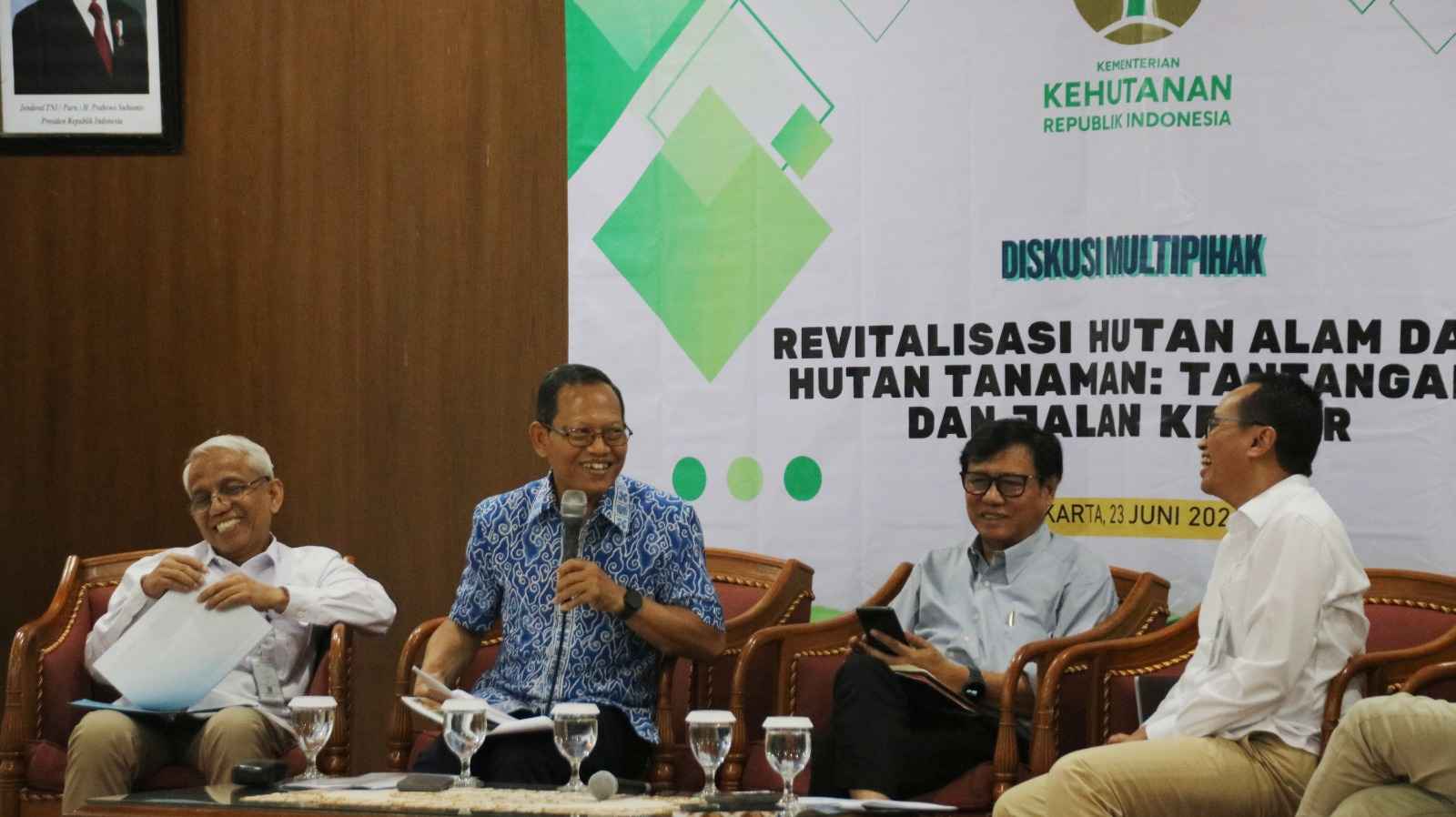
Enviro News Asia, Jakarta — Sustainable Forest Management (SFM) has emerged as a central pillar in supporting Indonesia’s FOLU Net Sink 2030 target, reflecting the strategic role of the forestry and land-use sector in the national greenhouse gas emission reduction agenda. This issue was highlighted during an Enviro Talk discussion organized by Enviro News, featuring Dr. Agus Justianto, Project Director of FOLU Net Sink 2030 and Member of the Expert Advisory Council of Indonesia’s FOLU Net Sink 2030, alongside Ir. Diah Suradiredja, Secretary General of ATKARBONIST (the Association of Sustainable Carbon Business Practitioners), on Monday (29/12/2025).
Agus Justianto explained that the FOLU Net Sink 2030 commitment originates from the dynamics of global climate change negotiations, where the forestry sector is regarded as the most visible and cost-effective sector for reducing emissions. This commitment aligns with the REDD+ framework and has evolved toward a nature-based solutions approach. “Indonesia possesses significant capital in the form of tropical rainforests. Based on studies and calculations conducted, the FOLU sector has become the backbone of national greenhouse gas emission reductions,” Agus stated.
He noted that approximately 60 percent of Indonesia’s emission reduction burden lies within the FOLU sector. Accordingly, the government has positioned the FOLU Net Sink 2030 policy as an integral component of Indonesia’s Nationally Determined Contribution (NDC). The net sink target is defined as a condition in which carbon sequestration from the forestry and land-use sector is at least equal to, or exceeds, the emissions released by 2030. Agus acknowledged that the target is ambitious, particularly given Indonesia’s long-term commitment to achieving net-zero emissions by 2060 or earlier. Nevertheless, he emphasized that the success of FOLU Net Sink 2030 depends heavily on policy consistency and broad stakeholder support.
“This is not merely a state-level commitment. Consistent implementation at both national and subnational levels is critical, as disturbances such as forest fires and degradation can significantly affect target achievement,” he said. In terms of implementation, Agus underscored the importance of SFM, which has been a foundational principle of Indonesia’s forestry sector since the 1970s through agreed forest land-use planning and spatial planning frameworks. Forest classifications—production forests, protection forests, and conservation forests—have been determined based on scientific criteria, including rainfall, slope, and soil erodibility. “The concept of sustainable forest management has been established for decades. The challenge lies in ensuring its consistent application on the ground,” Agus added.
Meanwhile, Ir. Diah Suradiredja highlighted that FOLU Net Sink 2030 serves as a national policy compass for the business community and the carbon market. According to her, carbon markets are highly sensitive to policy direction certainty and credible governance. “FOLU Net Sink 2030 sends a strong signal that Indonesia positions forests and land as national climate solutions. This is crucial for the private sector, as carbon markets are built on trust and policy certainty,” Diah stated.
She explained that carbon markets are not merely trading mechanisms, but alternative financing instruments designed to address public budget limitations, particularly in financing forest restoration, sustainable forest management, and ecosystem protection at the site level. Diah stressed that community involvement is vital, as real emission reduction actions take place on the ground. Carbon compensation funds, she noted, are ultimately intended to support local communities in safeguarding forests from deforestation pressures, fires, and degradation. “Carbon markets represent compensation funding. Community roles at the site level are decisive in determining the additionality of emission reduction efforts,” she said.
Regarding governance, Diah emphasized the importance of data transparency and credibility. She noted that global investor confidence hinges on sound methodologies, robust monitoring, reporting, and verification (MRV) systems, and regulatory certainty. “Carbon markets do not tolerate ambiguous data. Transparency is the primary foundation for ensuring credibility in the eyes of the public and the global community,” she concluded.
The discussion reaffirmed that FOLU Net Sink 2030 is not merely a technical target, but a reflection of Indonesia’s development trajectory, which seeks to balance economic growth, environmental protection, and global responsibility. (*)