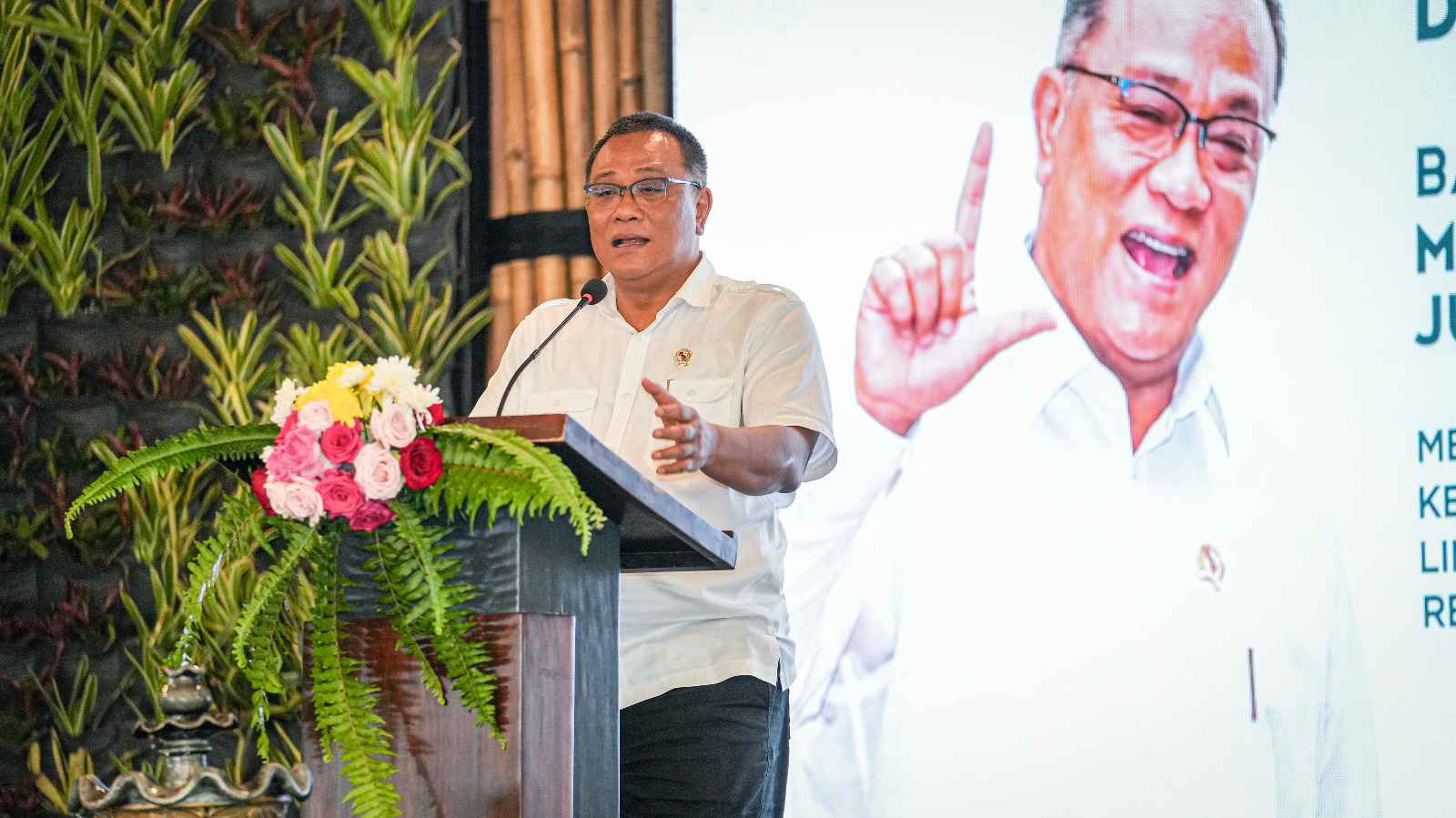
Enviro News Asia, Tangerang — The Ministry of Environment/National Environmental Protection Agency (KLH/BPLH) officially concluded the Environmental Governance Coordination Meeting (Rakor Tata Lingkungan), held over two days from 25–26 November 2025 at Atria Hotel Gading Serpong, Tangerang. On this occasion, Vice Minister of Environment/Vice Head of BPLH, Diaz Hendropriyono, underscored that accelerating regional environmental protection and management planning is a critical foundation for strengthening Indonesia’s resilience against escalating disaster risks and ecological pressures ahead of the 2026 planning year.
Addressing a strategic forum that brought together government ministries and agencies, local governments, development partners, and businesses, Vice Minister Diaz stressed that the urgency of strengthening environmental governance has reached a point where delays are no longer acceptable. He highlighted the persistently high number of recurring floods, many of which occur even without extreme rainfall.
“Floods continue to occur with only moderately high rainfall. In Jabodetabek alone, since 2020 there have been at least 374 incidents, and we have not been able to resolve them all,” Diaz stated.
He explained that declining upstream vegetation cover and anticipated increases in land-use conversion over the next five years require serious attention. In this context, accelerating the preparation of ecological-based planning documents has become a strategic necessity for all regions, particularly the Regional Environmental Protection and Management Plans (RPPLH), which now serve as a principal reference reinforced by Presidential Regulation No. 26 of 2025.
Currently, 17 provinces have enacted Regional Regulations on RPPLH, while 19 others are still in the drafting process. Vice Minister Diaz called for accelerated alignment between central and regional authorities.
“The Minister’s directives are clear. We urge all regions to finalize their Regional Regulations on RPPLH, RPPEG, and RPPEM, and ensure that all environmental approvals are processed through AMDALnet,” he affirmed.
Diaz also noted historical inconsistencies in the development of environmental governance documents, which have resulted in uneven references across regions. He emphasized that 2025 marks a significant turning point, with all technical regulations finally completed.
“It has been 16 years since Law 32/2009, yet the technical regulations were only completed in 2025. With the issuance of the Government Regulations and ministerial procedures, this is our moment to correct course and ensure RPPLH becomes the primary reference for regional and national development,” he said.
Vice Minister Diaz further commended regional governments that have shown strong commitment to preparing Strategic Environmental Assessments (KLHS), Environmental Carrying Capacity and Assimilation Capacity Studies (D3TLH), and RPPLH. To date, 21 provinces have issued D3TLH decrees, and 17 provinces have completed RPPLH. He also acknowledged progress in preparing the Peatland Ecosystem Protection and Management Plan (RPPEG) and Mangrove Ecosystem Protection and Management Plan (RPPEM), which form the backbone of national ecosystem protection.
In the area of technology and data, Diaz highlighted the importance of system integration following the signing of an MoU between KLH/BPLH, the Geospatial Information Agency (BIG), and the Meteorology, Climatology, and Geophysics Agency (BMKG). This collaboration is expected to significantly enhance the accuracy of Indonesia’s environmental data.
“With the MoU with BIG and BMKG, we now have a far more precise data foundation for preparing all environmental planning instruments,” he explained.
Vice Minister Diaz also pushed for accelerated implementation of AMDALnet as part of a major transformation toward a more transparent and integrated environmental approval system. With 17 provinces already adopting AMDALnet, he urged complete nationwide adoption by next year. Responding to local governments’ concerns over limited human resources and time constraints in document preparation, Diaz reiterated the central government’s commitment to provide continuous assistance.
“We hear all feedback, criticism, and concerns from the regions. We do not intend to stop at meeting minutes alone. KLH will continue to provide real support,” he emphasized.
Closing the 2025 Environmental Governance Coordination Meeting, Diaz reminded stakeholders that environmental protection is a fundamental constitutional right as mandated in Article 28H(1) and Article 33(4) of the 1945 Constitution. He called on all stakeholders to strengthen collaboration toward sustainable regional development.
“We gather here to listen to each other and work together to improve the system in support of the President’s Asta Cita vision. Despite our limitations, KLH will continue to provide guidance,” he concluded.
The coordination meeting served as a national consolidation moment to ensure all provinces and districts/municipalities adopt coherent, measurable, and ecologically grounded environmental planning pathways. The forum, held since 25 November, also provided a platform for regional parliaments, environmental offices, development planning agencies, and businesses to strengthen environmental planning instruments while addressing governance challenges at the subnational level. (*)