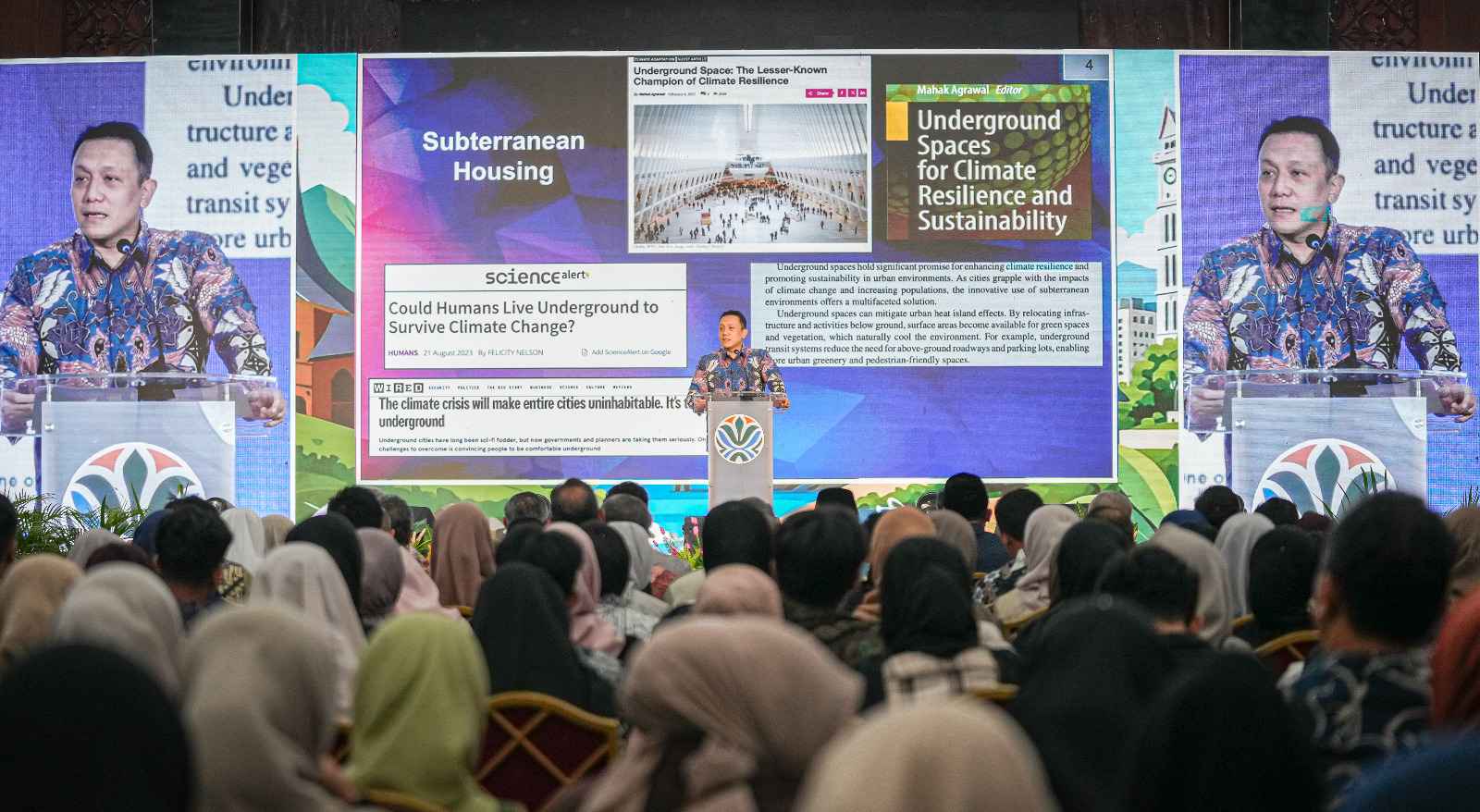
Enviro News Asia, Padang — Vice Minister of Environment and Vice Head of the Environmental Control Agency Diaz Hendropriyono has emphasized the importance of Strategic Environmental Assessment (SEA), known in Indonesia as Kajian Lingkungan Hidup Strategis (KLHS), as a key instrument for guiding regional development planning and reducing climate-related disaster risks.
Diaz made the statement during a Technical Coordination Meeting on Environmental Planning held by the Ministry of Environment/Environmental Control Agency (KLH/BPLH) at Andalas University (UNAND) in Padang, West Sumatra.
He also praised UNAND for taking the initiative to assist local governments in preparing SEA documents, which are expected to serve as a reference for regional spatial planning and climate change mitigation.
“I thank UNAND for starting to develop the SEA together with the Ministry of Environment. Hopefully, this can serve as a guideline for preparing regional spatial plans and help us mitigate threats from climate change,” Diaz said.
Diaz highlighted the declining vegetation cover in several areas of Sumatra, particularly within watersheds, which could increase the risk of floods and other climate-related disasters.
He said vegetation cover across several watersheds in Sumatra had declined significantly. In West Sumatra, around 9,000 hectares of vegetation cover had reportedly been lost across 18 watersheds between 2009 and 2024.
The Vice Minister stressed that SEA should play an important role in ensuring environmental considerations are incorporated into development and spatial planning decisions. Such planning, he said, is increasingly important as ecosystems face growing pressure from land-use changes and climate change.
Diaz also encouraged university students to contribute to climate change mitigation through practical actions in their daily lives. These include using public transportation, reducing excessive consumption and minimizing food waste, which can contribute to methane emissions when organic waste decomposes.
He also urged students to use artificial intelligence (AI) technology responsibly, pointing out that AI systems require significant amounts of electricity and water for computing and data processing.
“Most importantly, we need to be wiser in using AI because every time AI learns, it consumes significant amounts of electricity and water. We should not become trapped in excessive AI use,” Diaz said.
UNAND Rector Efa Yonnedi expressed support for the ministry’s call for greater sustainability efforts and said the university was continuing its transformation toward becoming a greener campus.
Efa said UNAND had established an integrated waste management center and was pursuing a zero-waste target. Although the university had not yet reached that target, it had begun processing organic waste such as leaves and branches.
Some of the processed waste is supplied to Semen Padang as an alternative fuel to substitute coal, he explained.
The coordination meeting was attended by West Sumatra Governor Mahyeldi Ansharullah, Vice for Environmental Planning and Sustainable Natural Resources at KLH/BPLH Sigit Reliantoro, Ministerial Expert Advisors Satyo Purwanto and Pupun Purwana, as well as other officials from KLH/BPLH. (*)