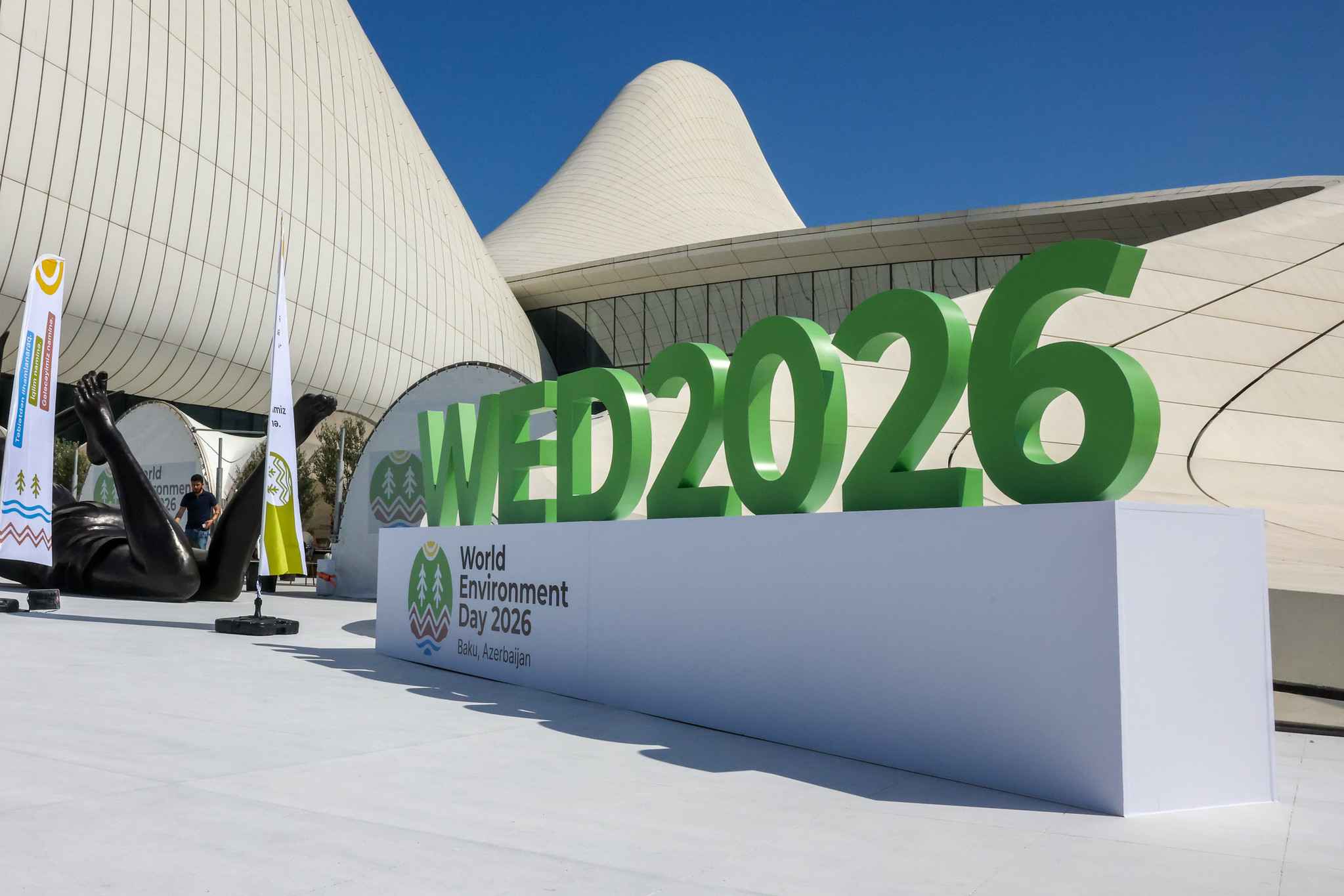
Enviro News Asia, Baku — United Nations Environment Programme (UNEP) Executive Director Inger Andersen has called for accelerated global climate action, warning that rising temperatures and intensifying climate impacts are threatening communities and ecosystems worldwide. Delivering a speech during World Environment Day 2026 celebrations in Baku, Azerbaijan, Andersen stressed that the climate crisis demands immediate and collective action.
Speaking at the 54th global observance of World Environment Day, which this year focuses on climate action, Andersen praised Azerbaijan for its continuing contribution to international climate efforts. She noted the country’s role in hosting COP29 in 2024, where governments agreed to mobilize US$300 billion in climate finance annually by 2035, and highlighted the recent World Urban Forum in Baku, which emphasized climate resilience in cities.
Andersen warned that climate change is already manifesting through increasingly severe heatwaves, droughts, floods, desertification, and dust and sandstorms. She said these impacts affect all nations but disproportionately burden poor and vulnerable populations. Azerbaijan itself faces mounting challenges, including degradation of mountain ecosystems and declining water levels in the Caspian Sea, which threaten fisheries, ports, infrastructure, and coastal communities.
Despite these challenges, Andersen emphasized that the future is not predetermined and that decisive action can still create safer, healthier, and more prosperous societies.
“Climate action is a huge opportunity for the nations and peoples of the world. If we act now, as a global community, we can prevent millions of deaths and trillions in economic losses by 2050,” she said.
Andersen pointed to the rapid expansion of renewable energy and electric mobility as evidence that solutions are already available and scaling up. She noted that renewable energy surpassed coal as the world’s largest source of electricity in 2025, strengthening energy security while accelerating decarbonization.
She also highlighted the role of cities in implementing climate solutions through sustainable cooling systems, climate-resilient buildings, urban greenery, and smart urban design. According to UNEP, combining passive cooling measures can reduce indoor temperatures by as much as eight degrees Celsius.
To strengthen urban adaptation efforts, UNEP launched the “50@50” initiative, bringing together more than 50 cities worldwide to share practical approaches to extreme heat preparedness and resilience.
Andersen further praised international efforts to reduce methane emissions and other short-lived climate pollutants. She commended Azerbaijan’s initiatives on organic waste management and methane reduction in the oil and gas sector, including cooperation between the State Oil Company of the Republic of Azerbaijan and UNEP’s Oil and Gas Methane Partnership 2.0.
She underscored the importance of reducing food loss and waste, improving building efficiency, and investing in ecosystem restoration. Healthy forests and ecosystems, she said, absorb carbon, regulate water resources, reduce disaster risks, improve air quality, and help communities adapt to climate change.
Andersen noted growing international momentum, citing a recent United Nations General Assembly resolution supporting the International Court of Justice’s ruling that countries have legal obligations to protect people and the planet from greenhouse gas emissions.
Nevertheless, she warned that global temperatures are likely to temporarily exceed the 1.5°C threshold established under the Paris Agreement. To address this, she called for a just, orderly, and equitable transition away from fossil fuels, increased investment in climate solutions, and stronger adaptation and disaster preparedness measures.
She noted that climate policies adopted since the Paris Agreement have already reduced projected warming from as high as 3.5°C to around 2.3–2.5°C by the end of the century if countries fully implement their pledges.
Andersen concluded by emphasizing that addressing climate change requires contributions from governments, businesses, communities, and individuals alike.
“World Environment Day is not just sending a message; it is passing one on. The planet has, for years, been sending signals that its limits are approaching. We must act on climate change as though our lives depend on it, because they do,” she said. (*)