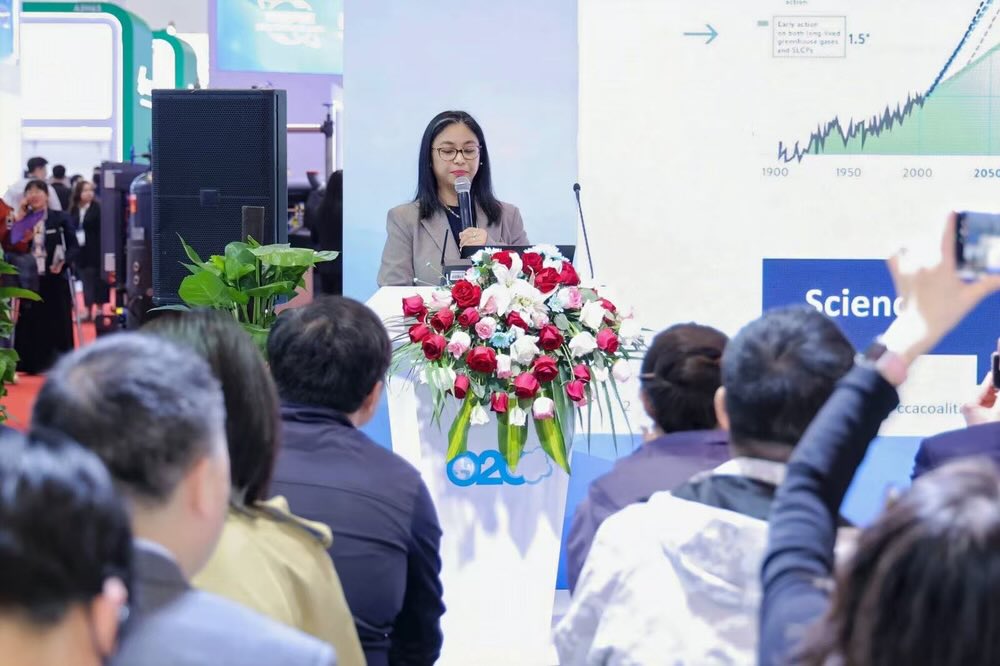
The Climate and Clean Air Coalition (CCAC) joined policymakers, industry leaders, and technical experts at the “Ozone2Climate (O2C) Technology Roadshow and Industry Roundtable” during the China Refrigeration Expo 2026, underscoring the urgency of aligning refrigerant management with energy efficiency improvements in the cooling sector. The event served as a key platform to advance ozone- and climate-friendly technologies while strengthening collaboration across sectors.
The Roadshow and Roundtable were organized by UNEP OzonAction, the United Nations Development Programme (UNDP), China’s Ministry of Ecology and Environment through its Foreign Environmental Cooperation Center (MEE-FECO), and the China Refrigeration and Air-Conditioning Industry Association (CRAA). Since its launch in 2011, the Ozone2Climate initiative has facilitated global and regional knowledge exchange on alternative technologies, and its 15th edition in China now supports the country’s HCFC Phase-out Management Plan for the refrigeration servicing sector.
This year’s Roundtable took place as countries marked the 10th anniversary of the Kigali Amendment and accelerated efforts to meet hydrofluorocarbon (HFC) reduction targets. Developing countries aim to cut HFC consumption by 10 percent by 2029, while also working toward a 97.5 percent reduction in hydrochlorofluorocarbons (HCFCs) by 2030. Discussions focused on scaling up climate-friendly alternatives while ensuring energy efficiency gains and reducing emissions throughout the lifecycle of cooling equipment.
Denise San Valentin, Programme Management Officer at CCAC, stressed the importance of integrated approaches during the session. “The Climate and Clean Air Coalition is very glad to collaborate with the government of China, CRAA, UNDP and UNEP OzonAction in enhancing collaboration among policymakers, industry and civil society in our common goals of cutting emissions of super pollutant gases in the cooling sector as well as improving energy efficiency simultaneously,” she said.
CCAC highlighted its ongoing efforts to help countries maximize the environmental benefits of the Kigali Amendment through early action on HFC reduction, lifecycle refrigerant management (LRM), and lowering energy demand from both new and existing cooling systems. Through its Cooling Hub, the coalition works with governments and partners to build capacity, raise awareness, and deploy practical solutions, including digital monitoring systems, low global warming potential technologies, and improved efficiency standards.
The coalition has also supported national-level initiatives such as the development of cooling action plans and regulatory frameworks, complementing financing mechanisms like the Multilateral Fund. These efforts aim to accelerate adoption of sustainable technologies while addressing emissions across the full lifecycle of refrigerants.
Scientific projections indicate that full implementation of the Kigali Amendment could prevent up to 0.1°C of global warming by 2050 and as much as 0.4°C by 2100. Additional emissions reductions—potentially up to 260 billion tonnes of carbon dioxide equivalent by mid-century—can be achieved through enhanced energy efficiency in refrigeration and air-conditioning systems.
Industry stakeholders continue to play a central role in this transition by advancing alternative technologies and supporting their deployment. However, participants noted persistent challenges, including technology costs, supply chain limitations, and safety considerations related to new refrigerants, such as flammability and operating pressure.
The Roundtable provided a platform to address these barriers through dialogue on policy design, technology selection, and implementation strategies. As global demand for cooling rises, particularly in regions experiencing higher temperatures, participants emphasized the need for solutions that simultaneously deliver energy efficiency and low emissions.
By promoting lifecycle refrigerant management alongside improved cooling efficiency, initiatives such as Ozone2Climate aim to help countries meet climate targets while supporting sustainable development and energy security goals. (*)